
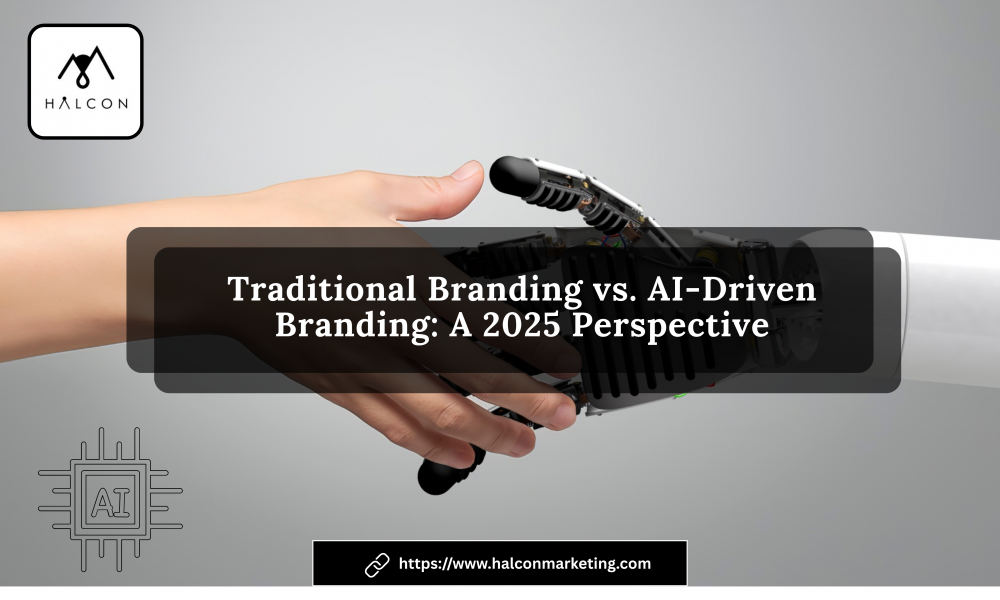
The brand-building landscape differs considerably from how it was a few years ago. An entire model of traditional branding, which used to be the norm, is now next to sophisticated AI-driven methods, which are changing the horizons of what can be achieved with brand strategy services. By 2025, the convergence of AI-Branding and age-old brand philosophy will continue yielding rewards and complications for brands that strive for deeper audience engagement.
The Enduring Foundation of Traditional Branding
Regardless of the advances in technology and the availability of online tools, traditional branding services are stubbornly clinging to their methods because of their one-to-one value. A traditional brand maintains through a machine's lack of emotional intelligence and the ability to plan strategically. These elements still possess value in effective brand development.
Human-Centered Creativity
Branding is an area where human and original creative thinking come into play. An experienced brand strategist's intuition in culture, emotional pitches, and creativity is hard to mimic with an algorithm. In the realm of comprehensive brand marketing services, this dimension of creativity sets people apart and ensures that brands are capable of emerging as truly distinct.
The storytelling aspect of traditional branding shows particular resilience against complete automation. Creating stories that resonate with the audience often requires emotion, intelligence, and experience, which human strategists provide. This supports why human strategists are needed to construct the narrative frameworks that form the emotional context brands occupy within consumers’ minds. This value-laden “mental real estate” is likely to be more challenging for data-driven methodologies to pinpoint.
Relationship-Based Strategy Development
In contrast, brand strategy services focus on stakeholder collaboration and network-based insight by employing interviews, workshops, and system designs. In contrast to a unilateral approach, this makes it possible to integrate multiple perspectives, cultivate shared purpose, brand vision, and detect hidden organizational relations that do not manifest clearly within the metrics and thus freely influence the execution of the brand.
While alternative AI-driven models tend to seek cost efficiency and scalability, this high-touch model preserves value due to the deeper strategic comprehension and organizational alignment achieved. Given the intricate challenges posed by brands that multiple constituents prioritize and seek to resolve, the contributing value of proficient brand consultants to these complex situations using compassion and skill to politically navigate divergent interests through effective brand marketing frameworks remains unparalleled.
The Transformative Impact of AI in Branding
By the time we reach the end of 2025, the advent of artificial intelligence will have changed many facets of the branding process. Today’s branding tools and services are accessible with modern advances in technology and AI, and nowadays, branding services utilize more powerful tools compared to the basic automation algorithms of previous years.
Data-Driven Strategy Formation
At the very least, AI has impacted the strategy service branding with the capability of analyzing existing data. Current AI technologies now allow apps dedicated to branding to analyze billions of data points and capitalize on market opportunities with impeccable precision.
With the extensive analytical power offered by AI systems, brand marketers can serve very narrowly defined audiences with tailored branding. Instead of having set brand strategies, AI systems create dynamic strategies based on simulations of brand performance in various scenarios, and recommend optimal positioning based on objectives postulated by the organizational resources.
Personalization at Scale
With traditional branding, all branding touchpoints have to undergo some level of dictated resemblance. New algorithms make it easy for individual consumers to have a hand in the way their brands are displayed, provided the core components remain unchanged. More and more, brand marketing services provide systems rather than guidelines, which allows for automated brand experience generation within set boundaries.
This advancement reshapes brand interactions on digital engagement channels. Content, imagery, communication, and even the products offered change based on the individual consumer’s context and preferences. The most sophisticated brand marketing solutions now seamlessly blend traditional core branding elements with AI systems that reliably compute and refine interactions based on user data and preferences.
Predictive Brand Performance
Like other branding services, overseas branding services seem to suffer from a lack of ROI evaluation due to the imprecise nature of brand equity. This has hugely improved through AI and now allows processes relying on predictive modeling, which estimate the impact of various brand strategies on specific business metrics beforehand.
These capabilities can be used to test countless strategic pivots virtually, thus lowering the risk of brand spending. AI-powered brand strategy services simulate consumer reactions to various positioning, visual identity, and messaging frameworks, ensuring a level of certainty that was impossible without real market tests.
The Emerging Hybrid Approach
As new developments in branding technology occur, the incorporation of a traditional approach with an AI-one becomes increasingly relevant within the scope of effective brand marketing.
Human Direction, AI Amplification
Branding contemporary services utilizes strategies made by human planners, while heavily relying on AI for scaling, hypothesis verification, and cross-channel automation. This synergy constitutes the best of both worlds by keeping the sensitive domain of imagination and thinking AI for analytics and execution bolstered by efficiency.
In practice, humans usually set the brand purpose, values, and positioning basics, while AI validates these steps through data analysis, improves and implements creative execution, and optimizes cross-channel deployment. The hybrid methodology enhances emotional resonance on strategies crafted along with verifiable data.
Continuous Brand Evolution
Another shift within the fundamental spectrum is moving from periodic rebranding to evolving brands continuously. These incremental adaptations made by the brands in response to real-time performance metrics, AI enables a new way of executing branding strategy, blending strategic coherence with brand marketing.
This approach to evolution indicates that providing brand strategy services increasingly means creating flexible systems as opposed to stable, fixed identities. Today’s brand guidelines often incorporate algorithms and decision-making tools that allow for uniform but flexible brand articulation throughout a vast and ever-expanding constellation of interactions.
Making Strategic Choices in a Dual Landscape
It is critical for businesses grappling with fundamental branding issues in 2025 to know when to fall back on established methods and when to use AI solutions. Understanding this balance is important:
When Traditional Methods Excel
Traditional branding methods remain crucially important for:
- Intense brand realignment that requires heavy organizational realignment at all levels.
- Heritage brands that require context rooted in history and culture.
- Complicated stakeholder systems that require navigational skills.
- Challenger brands that focus on aggressive disruption against already established brands.
- Situations recovering from crisis that require people-centered profit interactions.
In these contexts, seasoned brand consultants, even with AI supplements, bring a depth of emotional intelligence, facilitation skills, and creativity that remains unmatched.
When AI-Driven Approaches Deliver Superior Results
On the contrary, AI-enabled solutions for brand marketing show specific advantages concerning:
- Set environments with rich and extensive data on consumers’ behavior
- Digital-first companies operating in measurable, scopeable, and channel-specific spaces
- Highly contested markets requiring laser-focused targeting
- Multinational corporations aiming for cross-border harmonization in execution
- Businesses focusing on audiences expecting sophisticated personalized communication with AI tech
Digital-first companies working under these parameters often benefit greatly from AI-powered branding services offer accuracy, ease of personalization, and execution efficiency.
Conclusion: The Strategic Integration Imperative
The difference made by the cut-off date of 2025 suggests that the separation made between classic and AI-utilizing branding is increasingly based on differences, and that the gap no longer exists. The best sophisticated brand marketing services these days use both tools in combination, as branding today requires human imagination alongside algorithms and human-calibrated machines.
Seeking the upper hand in the competition changes with the question shifting from “should I apply old-fashioned methods or AI methods?” to “how should they be optimally mixed?” The most successful brands are those adopting a human strategy supported by AI-powered analysis and implementation, emotion coupled with precision through large-scale AI.
This integration of technology and human skills not only marks the current progress of solutions in brand marketing but also highlights its future trajectory. An integrated approach like this will lead to the formation of brands using human creativity alongside technological advancement in a manner never seen before, making them more relevant, flexible, technologically advanced, and impactful.