
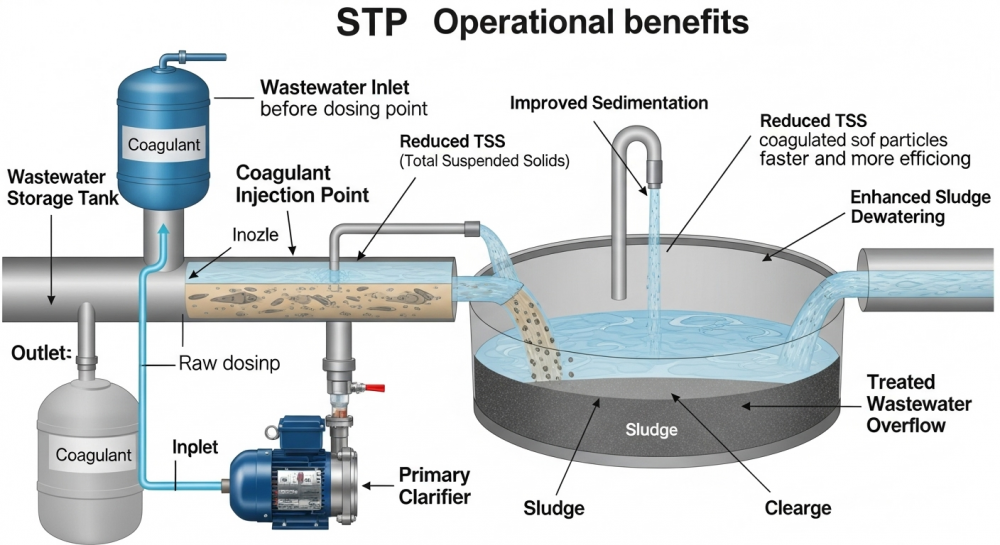
In modern sewage treatment plants (STPs), precision in chemical dosing plays a vital role in ensuring effective, compliant, and cost-efficient wastewater treatment. Among the many components that support this goal, dosing pumps stand out as essential tools for enhancing plant performance. Let’s explore how an STP dosing pump contributes significantly to treatment efficiency.
1. Precise Chemical Delivery Minimizes Waste
Dosing pumps—whether diaphragm, peristaltic, or plunger-type—offer highly accurate volumetric control, delivering chemicals with tolerances as tight as ±1 % groupkiron.com. This precision ensures optimal usage of coagulants, pH adjusters, disinfectants, and flocculants—reducing overuse, minimizing cost, and ensuring regulatory compliance.
2. Enhanced Process Stability & Flexibility
Mechanical dosing pumps, especially those with integrated motor protection and sensor feedback, greatly improve process stability. Features like temperature monitoring and PI (Proportional–Integral) controllers help prevent issues like water hammer and cavitation while enabling smooth dosing adjustments Illinois Process Equipment. This leads to reliable dosing under variable flow and load conditions.
3. Operational Efficiency & Cost Savings
Accurate dosing means using exactly what's needed—leading to measurable chemical and operational savings. By avoiding over-dosing, plants experience lower chemical costs and reduced downtime. For instance, peristaltic metering pumps (like the WMFTS Qdos series) adjust flows from 0.1 mL/min up to 2,000 mL/min, enabling precise, demand-based dosing wmfts.com.
4. Improved Treatment Quality & Regulatory Compliance
Accurate chemical control improves treatment outcomes—whether it's coagulation, disinfection, or pH balance—ensuring effluent quality consistently meets strict discharge standards. High-quality dosing pumps help avoid both under-treatment and harmful overdosing Romegamartveritoengineering.com. This is crucial for compliance, especially as environmental regulations tighten globally wmfts.com.
5. Durable, Maintenance-Friendly Design
Modern dosing pumps are often constructed with corrosion-resistant materials (e.g., PTFE, stainless steel, PVC), enabling them to withstand aggressive chemicals and harsh treatment environments with minimal servicing groupkiron.com. Many models are modular and easy to maintain, reducing downtime and maintenance costs.
6. Automation & Advanced Control Integration
Many dosing pumps today are automation-ready, integrating seamlessly with plant control systems and SCADA. Automated dosing adjusts in real time based on feedback from sensors (e.g., pH, chlorine levels), yielding faster responses to changing water characteristics and further optimizing chemical use groupkiron.comValmet. Advancements such as Flowrox's metering pumps and valves exemplify how automation and reliable flow control reduce environmental impacts and energy use Valmet.
Summary Table
| Benefit | How Dosing Pumps Help |
|---|---|
| Chemical precision | Tight volumetric control minimizes waste |
| Process stability | Integrated controls reduce mechanical issues |
| Cost-efficiency | Demand-based dosing saves money over time |
| Effluent quality & compliance | Accurate dosing supports regulatory adherence |
| Durability & maintenance | Corrosion-resistant, modular design lowers upkeep |
| Automation integration | Smart dosing adapts in real time, enhancing control |
Ready to Upgrade?
High-quality dosing pumps are an excellent investment for any STP operator aiming to reduce costs, improve treatment consistency, enhance compliance, and streamline operations.
For specialized solutions in chemical dosing tailored to wastewater management, consider exploring products at Greenify—a platform dedicated to sustainable environmental technologies.