
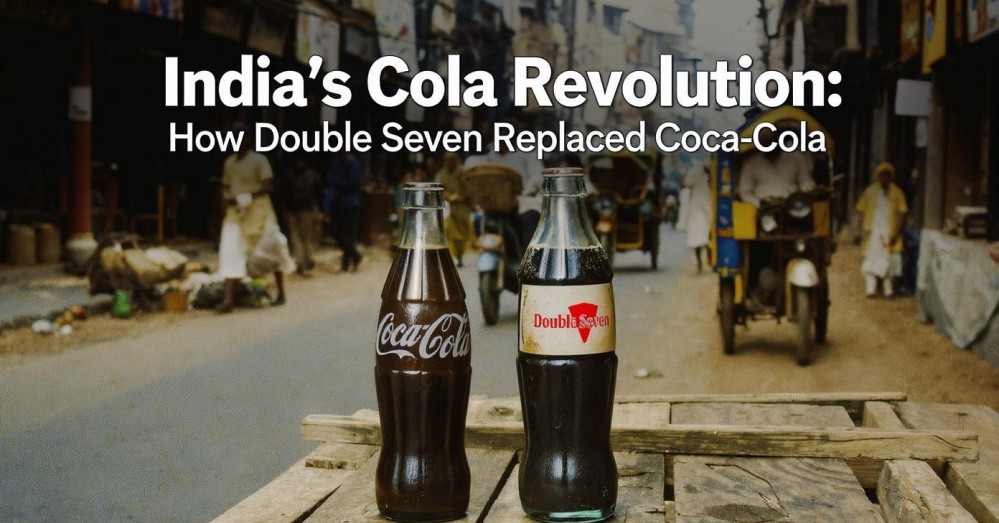
The exit of Coca Cola in 1977 marked a turning point in India’s Cola Revolution, creating a unique opportunity for domestic alternatives. The Indian government responded with Double Seven, a state-backed cola brand aimed at replacing the multinational giant. This launch represented not only a commercial initiative but also a cultural statement, reflecting India’s desire for self-reliance and national pride in the consumer market.
Coca Cola’s Exit and Policy Background
Coca Cola withdrew from India following government regulations requiring foreign companies to reduce ownership stakes in Indian subsidiaries. The company, unwilling to share its proprietary formula, chose to leave. Recognizing the gap in the market, the Janata Party government launched Double Seven through Modern Food Industries. The brand name commemorated the year 1977 and symbolized a bold step toward asserting India’s cultural and economic independence in the beverage sector.
Launch and Marketing Approach
Double Seven was introduced to the public at Pragati Maidan, New Delhi, with substantial promotion. The marketing emphasized the brand’s Indian origin, portraying it as a patriotic alternative to Coca Cola. Slogans like “For the Good Times” highlighted optimism and national pride, appealing to consumers’ sense of identity. Government backing lent credibility but also raised expectations for taste, quality, and overall product experience.
Consumer Response and Market Challenges
Despite its patriotic positioning, Double Seven faced significant challenges in capturing consumer loyalty. Many consumers were accustomed to Coca Cola’s international flavor and found it difficult to adapt to the new taste. Limited distribution networks and the lack of private-sector involvement further constrained the brand’s reach. These factors limited its ability to gain a competitive foothold in the market dominated by global standards.
Political Influence on Brand Fate
The return of Indira Gandhi in 1980 shifted political priorities. Double Seven, closely associated with the previous government, lost institutional support and promotional initiatives. Without consistent investment and private-sector engagement, the brand gradually disappeared from stores, ending its brief competition against Coca Cola in the Indian market.
Lessons from the Cultural Clash
Double Seven’s story demonstrates the challenges of replacing a global brand with a domestic alternative. Government endorsement alone was insufficient to overcome consumer preferences, distribution hurdles, and entrenched brand loyalty. Nonetheless, the experiment highlighted India’s efforts to assert self-reliance and provided insights into how culture, politics, and commerce intersect in consumer markets.
Coca Cola’s Re-entry and Market Evolution
Economic reforms in the 1990s paved the way for Coca Cola’s return in 1993 via joint ventures. This marked a shift from protectionism to liberalization, emphasizing the need for strategic partnerships and consumer-oriented approaches. Although Double Seven did not survive, it remains a significant episode in India’s Cola Revolution and a lesson in the complexities of cultural and market dynamics.
Double Seven’s clash with Coca Cola represents a key chapter in India’s Cola Revolution, combining nationalism, politics, and commerce. While the brand was short-lived, it reflects India’s ambition to foster self-reliance and serves as a historic example of domestic attempts to compete in a globalized market.
Read Full Article : https://bizinfopro.com/news/marketing-news/indias-cola-revolution-how-double-seven-replaced-coca-cola/
About Us : BizInfoPro is a modern business publication designed to inform, inspire, and empower decision-makers, entrepreneurs, and forward-thinking professionals. With a focus on practical insights and in‑depth analysis, it explores the evolving landscape of global business—covering emerging markets, industry innovations, strategic growth opportunities, and actionable content that supports smarter decision‑making.