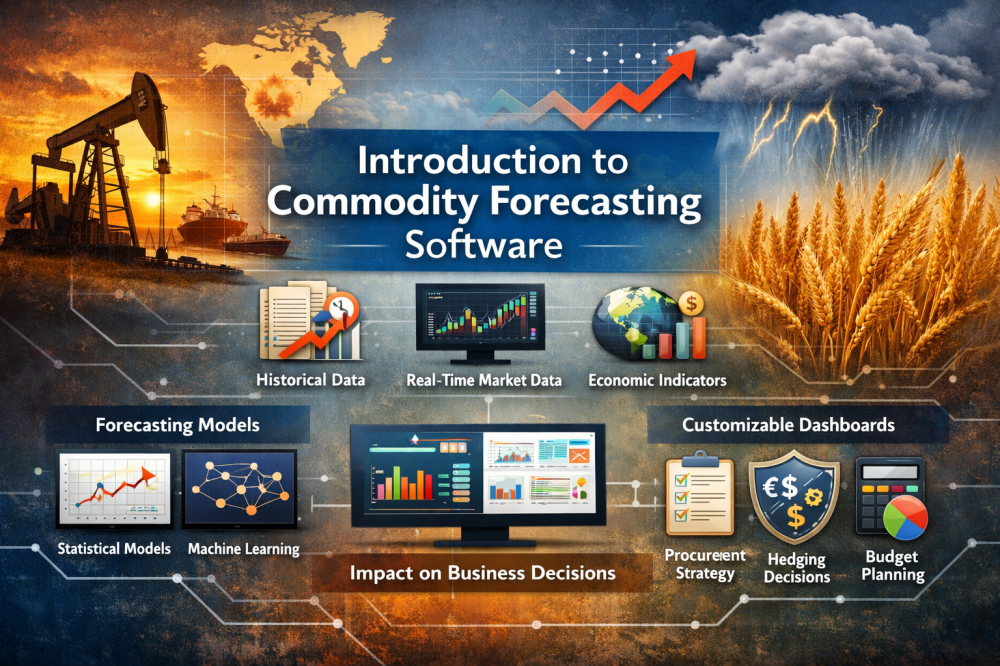
Introduction to Commodity Forecasting Software
Commodity markets are inherently volatile, driven by supply-demand imbalances, geopolitical developments, weather patterns, and macroeconomic conditions. Commodity forecasting software plays a critical role in helping organizations anticipate price movements and plan strategically. These tools combine historical data, real-time prices, and analytical models to support better forecasting and decision-making across procurement, treasury, and investment functions.
Core Data Inputs and Their Importance
The foundation of any forecasting software lies in data quality and coverage. Reliable platforms integrate decades of historical commodity prices, real-time spot and futures data, and relevant macroeconomic indicators. Long-term datasets allow users to identify trends, cycles, and seasonality, while real-time feeds ensure forecasts remain current. The tradeoff, however, is cost and complexity—maintaining extensive data coverage requires significant infrastructure and data partnerships.
Forecasting Models and Analytical Approaches
Forecasting software typically employs a mix of statistical models and advanced analytics. Traditional econometric models offer transparency and are easier to interpret, making them suitable for budgeting and governance. Machine learning models, on the other hand, can detect complex patterns and adapt to market changes, but often lack explainability. Organizations must balance predictive accuracy with interpretability, especially when forecasts directly influence financial commitments.

Usability, Customization, and Adoption Challenges
Ease of use is a major determinant of success. Forecasting tools must provide intuitive dashboards, customizable scenarios, and clear visualizations to support non-technical users. Overly complex systems risk low adoption, while overly simplified tools may overlook critical market signals. Customizable dashboards and flexible access—via web, Excel, or mobile—help bridge this gap.
Impact on Business Decisions
Forecasts directly affect procurement strategies, cost negotiations, hedging decisions, and budget planning. Inaccurate forecasts can lead to higher costs or missed opportunities, while well-informed projections improve resilience and cost control. As a result, forecasting software increasingly integrates with broader commodity intelligence and financial analysis platforms.
Evolving Platforms and Market Intelligence
Modern solutions, such as Tresmark’s commodity intelligence platform, demonstrate how forecasting software is evolving. By combining real-time data, 30+ years of commodity history, economic forecasts, and customizable dashboards, these platforms support diverse users—from procurement teams and analysts to asset managers and investors.
Conclusion
Commodity forecasting software does not eliminate uncertainty, but it improves preparedness. Organizations that carefully balance data depth, analytical sophistication, usability, and integration are better positioned to navigate volatile commodity markets and make informed, forward-looking decisions.