Every January, we pause to honor Dr. Martin Luther King Jr. — not as a sanitized icon, but as a strategist, philosopher, and moral architect whose ideas still confront us. His dream was never just about racial harmony. It was about the Beloved Community: a society where justice is rooted in dignity, where conflict is resolved through dialogue, and where the humanity of every person is protected.
In his final book, Where Do We Go From Here: Chaos or Community?, Dr. King warned that America was drifting toward polarization, retaliatory rhetoric, and a dangerous abandonment of nonviolence — not only in action, but in speech. He understood that violence begins long before fists are thrown. It begins in the words we choose, the labels we deploy, the ways we flatten human beings into enemies.
And if I’m honest, I fail at this more often than I’d like. I’ve spent decades in activism, and even with all that experience, I still find myself slipping into the language of frustration, anger, and exhaustion. It happens when you’ve fought the same battles for years. When you’ve watched systems resist change. When you’ve stood beside people who are hurting and felt powerless to protect them. When you lose sight of the deeper conviction that brought you into the work in the first place. But that’s the point of a conviction: if it never convicts you, it isn’t a conviction at all. King’s philosophy forces us to recenter, to reset, to realign ourselves with the moral compass we claim to follow.

That recentering is something I learned to do intentionally. I have close friends who own a home in Crossville, Tennessee — a quiet parsonage once used by the Cumberland Presbyterian Church. For years, the church hosted students there. One of those students, staying in that very house, conceived the idea that would become the Highlander Folk School — the training ground for labor organizers, civil rights leaders, and generations of movement builders. It’s the place where Myles Horton refined the tools of democratic education, where Rosa Parks trained before she ever refused to give up her seat, where Dr. King found space to think, strategize, and imagine a different America.
My friends offered that home to me as a retreat more than once, and I took them up on it. I haven’t been there in a while, but I can still feel the quiet of that place — the way the walls seem to hold the echoes of every conversation that shaped a movement. And come to think of it, in this political atmosphere, I could probably use some of that recentering again. I used to sit in that house and reflect on the power of what Horton began: the labor movement, the civil rights movement, the philosophy of nonviolence, the courage of ordinary people who refused to accept the world as it was. I went there to think, to study, to remember that movements are built not on slogans, but on discipline, imagination, and moral clarity.
And it’s from that place — literally and figuratively — that I approach the conversation we’re having today. Because if we’re going to talk about policing, protest, and the rhetoric that divides us, we have to begin with the principles Dr. King left us. His philosophy of nonviolence wasn’t sentimental or symbolic — it was a disciplined framework built on six core principles. First, that nonviolence is a courageous way of life, requiring strength rather than passivity. Second, that the goal of nonviolence is always friendship and understanding, not humiliation or domination. Third, that the target of nonviolence is injustice itself, not the people who may be participating in it. Fourth, that suffering, when willingly endured, can awaken the conscience of a nation. Fifth, that love — not sentimental affection, but a principled refusal to dehumanize — is the engine of nonviolence. And sixth, that justice is possible because the moral arc of the universe bends toward it, but only when people commit themselves to truth and courage.
Alongside these principles, King gave the movement a behavioral covenant — the 1963 Pledge of Nonviolence — where marchers committed to “refrain from violence of fist, tongue, and heart.” This is the clearest, most explicit place where King names violent speech. And when you place that pledge beside the third principle — “defeat injustice, not people” — the meaning becomes unmistakable. Violent speech is what happens when our words humiliate, dehumanize, or destroy people rather than confront the systems shaping them. It is what happens when slogans flatten human beings into symbols. It is what happens when we attack individuals instead of the forces of injustice.
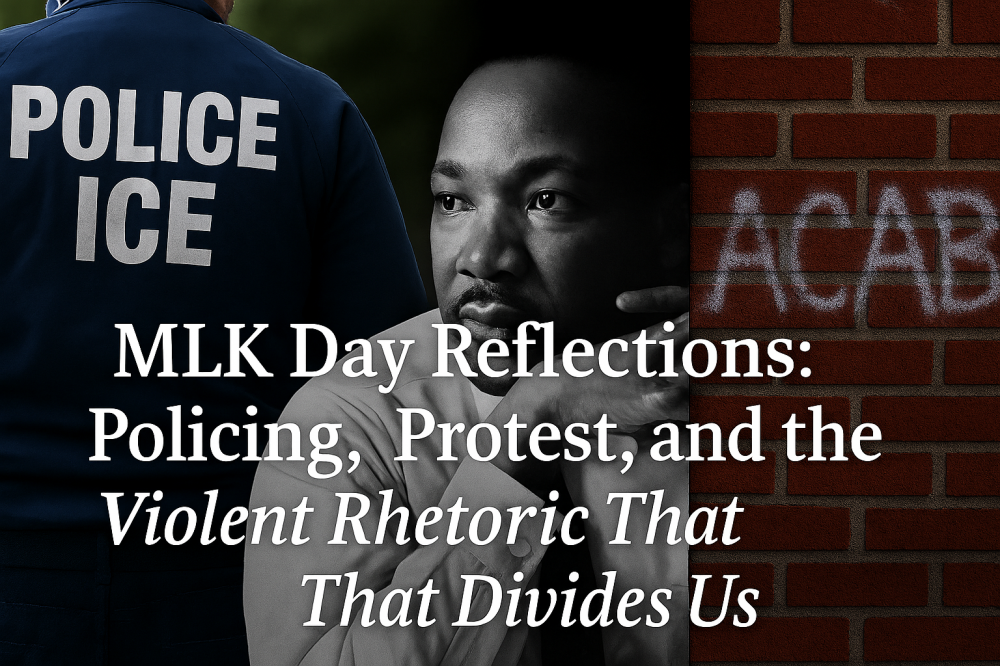
And this is where the ACAB slogan becomes morally complicated. ACAB is often defended as a critique of a system — a shorthand for “the policing system is structurally harmful.” But that is not what the words actually say. The words say all cops are bastards. The target of the slogan is not the system; it is the people inside it. The language collapses the distinction King insisted we maintain. It transforms a structural critique into a personal condemnation. It takes the anger we feel toward policies, histories, and institutions and redirects it toward human beings — many of whom are themselves fighting the very injustices we oppose.

This is violent speech in the Kingian sense. Not because it is loud or angry, but because it violates the boundary between confronting injustice and attacking people. It humiliates rather than invites understanding. It dehumanizes rather than opens the door to transformation. It treats individuals as embodiments of evil rather than participants in a flawed structure. And in doing so, it works directly against the purpose of the Beloved Community, which is reconciliation. You cannot reconcile with someone you have already declared irredeemable. You cannot build a future with people you have written off as enemies. You cannot create justice with the language of destruction.
This tension becomes even clearer when we look at what’s happening across the country. In cities like Chicago, Philadelphia, Minneapolis, Los Angeles, and others, local police departments are refusing to cooperate with ICE and Border Patrol. Not out of political posturing, but because federal agents have been operating outside the law, using tactics that provoke fear, destabilize neighborhoods, and undermine public safety. In Philadelphia, a police chief stood at a podium and said plainly that her officers would arrest any federal agent who committed a crime in her city — badge or no badge. In Chicago, local law enforcement has drawn a hard line against participating in raids that violate constitutional protections. In Minneapolis, officers have publicly criticized federal operations that terrorize immigrant communities and erode trust.
These are not the actions of “bastards.” These are the actions of people using their authority to protect the vulnerable — often at personal and professional risk. And they expose a truth that ACAB, as a slogan, cannot hold: sometimes the only thing standing between marginalized communities and federal overreach is a local police department willing to say no.
The deeper problem is not the slogan itself — it’s the way it blurs the line between systemic critique and personal condemnation. The ACAB worldview, in its most thoughtful form, argues that policing as an institution is structurally flawed. That it was built on racial hierarchy, class control, and state violence. That even well‑intentioned officers are constrained by a system designed to produce unequal outcomes. There is truth in that. But the slogan doesn’t say “the system is harmful.” It says all cops are bastards — a moral judgment on every individual who wears a badge.
And most people chanting it aren’t thinking about structural analysis. They’re thinking about the officer who shoved them, the department that covered up a killing, the system that has rarely been held accountable for its own abuses. The pain is real. The anger is justified. But the absolutism is counterproductive. Because when we collapse the system and the individual into one target, we lose the ability to recognize — or even imagine — the officers who are fighting from the inside to make things better.
I’ve worked with officers who spent their careers advocating for mental‑health crisis teams, only to be ignored by their own departments. Officers who protected undocumented families during raids. Officers who refused to participate in discriminatory policing, even when it cost them promotions. Officers who were themselves victims of racism within the system. These people exist. They are not theoretical. They are not rare. And they are not bastards. They are human beings navigating a system that often punishes compassion and rewards aggression. They are people who chose a profession because they believed — sometimes naively, sometimes stubbornly — that they could help. To deny their existence is to deny reality. To erase their contributions is to erase the possibility of reform. To condemn them alongside the officers who brutalize communities is to abandon nuance in favor of purity. And purity has never built a movement. It has only ever burned one down.
If we want real change — not symbolic victories, not viral chants, but structural transformation — we need a framework that can hold two truths at once: policing as a system has caused profound harm and must be reimagined, and individuals inside that system are not monolithic — and some are essential partners in the work ahead. This is not a comfortable position. It doesn’t fit on a sign. It won’t trend on social media. But it is the only position that honors both the history of harm and the humanity of the people trying to repair it.
And so, on this MLK Day, we are left with questions that demand courage, honesty, and humility. Are we willing to critique systems without dehumanizing the people inside them. Can we hold space for pain and still make room for dialogue. Are we prepared to confront injustice without adopting the language of violence ourselves. What would our movements look like if we reclaimed King’s discipline, not just his memory. And perhaps most importantly: do we want to win the argument, or do we want to win the future.