

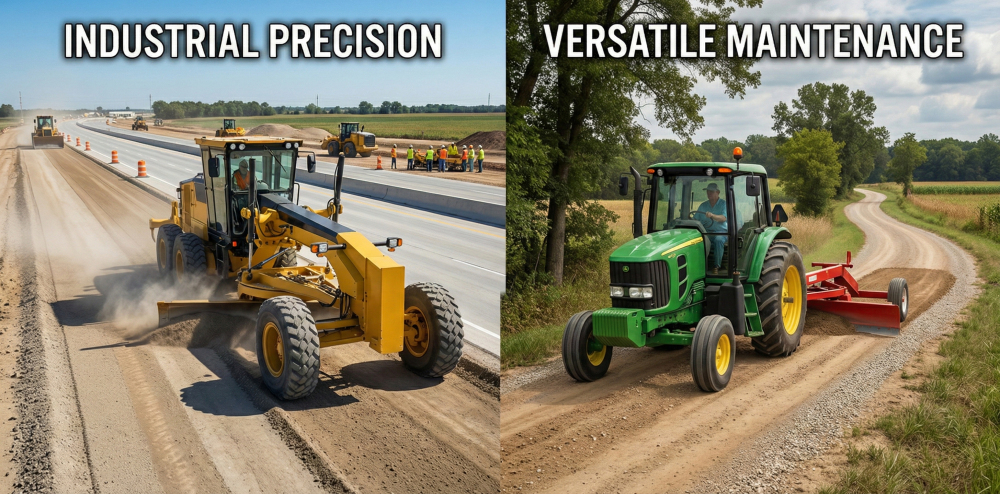
When considering equipment for road and earthwork projects, site managers must weigh various options to meet project deadlines. This often leads to a debate between self-propelled grader machines like Motor Graders versus the more traditional pull-behind Grader Blades.
Let’s assess:
Understanding Motor Grader Machines
Motor Grader machines are one of the most advanced pieces of grading equipment available due to their combination of

- Powerful diesel engines,
- Articulated frames, and
- Adjustable moldboard blades located between the axles.
These machines can be tilted, rotated, and operated by hydraulic pressure to perform fine grading tasks with the Flange-End (3-4m) Blade. Most motor graders range from 100-200 HP in size and use scarifiers to tear through hard-packed soils prior to leveling operations.
Motor Grader Machines are relied upon by site managers for their ability to efficiently grade new roads and create smooth cambered surfaces for water drainage. Many modern motor grader machines now include GPS for automated passes, resulting in up to a 15% decrease in fuel consumption during operation.
Exploring Traditional Grader Machines
Traditional grader machines are either pull-behind blades or towed by large vehicles, such as tractors or dozers. Because traditional grader machines require the traction of another vehicle, they are best suited for light-duty or portable operations on less than a full-time basis and on small to medium-sized jobsites. The blade angle on these machines is adjusted by the operator purely through manual labour and requires multiple passes to achieve the desired finish grade.
Traditional grader machines are commonly used for maintenance of other types of equipment; for example, ditch cleanouts and snow removal. However, they have limited ability to travel and operate on uneven terrain without the use of a prime mover. These machines are frequently used by managers of budget-conscious operations because of their relatively low price and ability to be paired with other equipment.
Key Features of Motor Grader Machines
Powerful Engine and Hydraulics
Motor grader machines pack 120-300 HP engines with six-wheel drive for traction on slopes. Hydraulic cylinders enable 360-degree blade rotation, supporting reverse grading to save time.

Articulated Frame Design
The frame articulates up to 25 degrees, letting motor grader machines navigate tight turns on urban sites. Tandem rear axles provide stability during heavy cuts.
Advanced Attachments
Rippers scarify hardpan up to 500mm deep; wing plows clear debris. Cab comforts include AC and joystick controls for 12-hour shifts.
Applications Demanding Motor Grader Machines
Road Construction Mastery
Motor graders are used to create a fine grade on sub-bases to within a +/- 12mm tolerance before paving to ensure a very smooth highway surface and are also used for shoulder maintenance and V-ditch creation for runoff management.
Site Preparation Efficiency
Motor graders are used to level pads at Airports or Mines and to uniformly spread out fill material over tens of hectares. In excavating earthmoving applications, a motor grader can backfill trenches after they have been dug.
Grader Machine Uses in Niche Scenarios
Motor graders are used extensively for rural road repairs due to their ability to be towed behind tractors for gravel redistribution. Also, quarries often utilise motor graders to quickly level the bases of stockpiles.
When Site Managers Choose Motor Grader Machines
When undertaking projects with either 5+ kilometres of roadway or 10+ hectares, it is best to select motor grader machines. They allow for up to a 20% reduction in cut passes as they allow for more precise cutting. Using circle charts to create the most efficient angles for blade position will provide a 10-15% savings on fuel consumption.
When working in Monsoon Zones, motor graders will allow you to remove mud much faster than towed motor graders.
Scenarios Favoring Grader Machines
Motor graders are ideal for use on smaller farms and village roads, where existing tractors can easily tow them for the lowest possible fleet cost. Rental operations like the ability to offer them for rent due to their portability.
Maintenance Tips for Motor Grader Machines
Below are the daily checks that you need to work on to maintain motor grader machines:
- Grease circle bearings,
- Inspect hydraulic hoses.
- Change oil every 250 hours
- Align blades post-500 hours to prevent uneven wear.
- Train operators on ripper depth to avoid frame stress.
For grader machines, sharpen blades quarterly and store blades rust-free.
Cost-Benefit Analysis for Site Managers
The ability to double productivity for a mid-sized business with motor grader machines gives them enough savings on fuel and labor to use those savings for other business expenses, such as financing equipment.
Future Trends in Motor Grader Machines
Electric hybrid motor graders reduce emissions by 40% and Artificial Intelligence-controlled blades provide five millimeters of accuracy. Technology, such as telematics used to monitor usage remotely, can improve fleet efficiency.
Final Thoughts
To make an informed decision on which grader machine to buy, you must assess the size of your property, soil type, and budget. You can rent motor graders for test runs and should consider the availability of ISO certified equipment and five-year warranties, as these will guarantee product satisfaction.
FAQs
- What is the difference between a Grader machine and a Motor Grader machine?
The Motor Grader machine is an independent machine that has full hydraulic blade control. Whereas, the Grader machine is towed behind a tractor to do basic grading. - When is it appropriate to use a Motor Grader machine?
For large construction sites such as roads, large mines or anything that requires a fine grade with a production rate of 500sqm/hr or more, use the Motor Grader machine. - How can you adjust the blade on a Motor Grader machine?
It has hydraulic tilting capability of 45°, a rotational capability of 360° and shifting capabilities side to side. With these features, cutting can be done in custom configurations. - Can you use a Grader machine for rough terrain like you can with a Motor Grader machine?
No, Grader machines are limited to flat ground conditions. They do not have enough horsepower to work on hilly terrain. - What is the average lifespan of a Motor Grader machine?
Typically, the average lifespan is about 15 - 20 years with proper maintenance; engines typically have over 10,000 hours of operational time. - How much fuel does a Motor Grader machine burn during a normal work shift?
Typically, the daily diesel consumption is between 20 - 40 liters for an 8 hour work shift on medium projects depending upon the technological upgrades. - Can you use a Motor Grader machine on urban building sites?
Yes, the articulated frame of a Motor Grader machine is designed to turn in tight spaces making it ideal for parking lots and sidewalks.





