
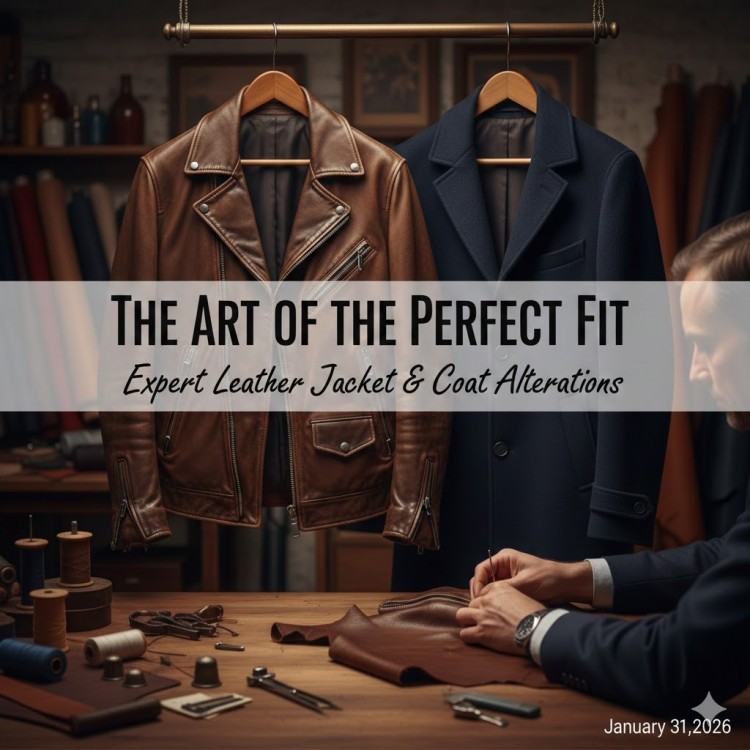
In this guide, we will explore why professional Leather Jacket alteration is essential and how expert tailoring can transform your favorite dress.
The Anatomy of Leather: Why Specialization Matters
The primary reason why you should never take a leather garment to a standard high-street tailor is the "one-shot" nature of the material. When a needle pierces fabric, the fibers usually push aside and can often close back up if a stitch is removed. When a needle pierces leather, it leaves a permanent hole. At BX Tailor, our artisans use industrial-grade leather needles and specialized silk-finish threads designed to "seat" perfectly within the hide, ensuring that every new stitch looks like it came from the original factory.
Specialized Machinery
Standard sewing machines lack the torque and the "walking foot" mechanisms required to move heavy leather through the feed dogs. Without the right equipment, the leather can stretch, bunch, or suffer from "scuffing" as it moves through the machine. We utilize heavy-duty machinery specifically calibrated for different weights of hide—from buttery-soft lambskin to rugged, heavy-duty cowhide.

The Precision of Leather Jacket Alteration
Many people leave beautiful leather pieces hanging in the closet because they are "a bit too big" or don't sit right on the frame. Professional leather jacket alteration can breathe new life into these garments, turning a generic fit into a tailored silhouette.
Shoulder Narrowing and Reconstruction
The shoulders are the most critical part of a jacket's architecture. If the shoulders are too wide, the jacket looks like it is wearing you, rather than the other way around. We can deconstruct the shoulder head, trim the excess leather, and reset the sleeve. This is a "surgical" procedure that requires a deep understanding of human anatomy to ensure the jacket moves naturally with the wearer's arms.
The Technical Challenge: Leather Jacket Sleeve Shortening
One of our most requested services is leather jacket sleeve shortening. It is a common problem: a jacket fits perfectly in the chest and shoulders, but the sleeves hang down past the knuckles.
Shortening from the Cuff
Need Leather jacket sleeve shortening? If the sleeve is plain, we can shorten it from the bottom. However, most high-end leather jackets feature zips, studs, or intricate stitching at the cuff. Shortening from the bottom in these cases involves relocating the zip higher up the arm—a process that requires precision to ensure the "teeth" of the zip align perfectly and the leather finish remains clean.

Shortening from the Shoulder
In cases where the cuff detail is too complex to move (or if the sleeve is tapered in a way that would be ruined by bottom-shortening), we perform leather jacket sleeve shortening from the shoulder. We detach the sleeve entirely, remove the excess length from the top (the sleeve cap), and re-attach it to the armhole. This ensures that the beautiful detailing at your wrist remains completely untouched and original.
Engineering Elegance: Leather Coat Alteration
A leather coat—whether it’s a trench, a car coat, or a long duster—carries significantly more weight and surface area than a jacket. Therefore, leather coat alteration requires a focus on balance and "drape."
Relining and Internal Restoration
Often, the exterior leather of a coat is in great condition, but the interior lining has shredded or become stained over the years. As part of our alteration service, we can completely reline your leather coat with premium silk, satin, or quilted thermal materials. This not only improves comfort but allows us to inspect and reinforce internal seams from the inside out.
Understanding the Types of Leather
Different hides require different tailoring philosophies. At BX Tailor, we categorize our approach based on the material:
- Lambskin/Nappa: Extremely soft and thin. It requires "microsurgical" precision and very fine needles to prevent the leather from tearing under the tension of the thread.
- Cowhide/Bovine: Thick and durable. This requires high-torque machines and heavy-duty bonded nylon threads that can withstand the weight of the garment.
- Suede/Nubuck: These have a "nap" (a fuzzy surface). We must handle these in a sterile environment to avoid oil transfer from the hands, and the stitching must be buried deep into the nap for an invisible finish.
Caring for Your Leather Post-Alteration
Once your garment has been professionally tailored, proper home care is essential:
- The Right Hanger: Use a wide, padded hanger. Wire hangers can create "shoulder nipples" that may eventually require further leather jacket alteration to fix.
- Breathability: Never store leather in plastic. It needs to breathe. Use a cotton garment bag.
Now, for Leather Coat Alteration, please visit https://bxtailor.co.uk/





