
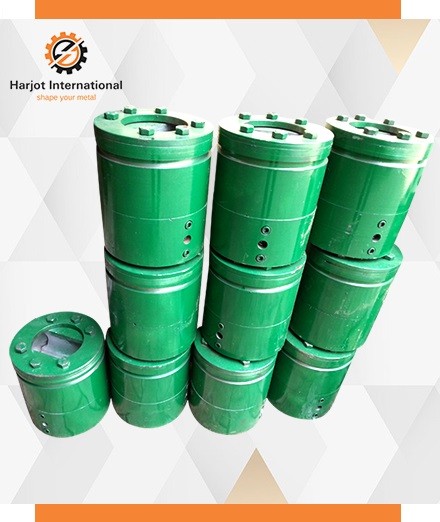
In the world of industrial machinery, keeping everything moving smoothly isn't just a goal; it’s important for safety and performance. This is where the Universal Coupling helps to do this perfectly. The component acts as a bridge between two rotating shafts, allowing power and torque to flow seamlessly from one to the other. It can handle "misalignment." In a perfectly aligned factory, shafts would line up exactly, but in a busy factory or a moving vehicle, factors like heavy vibrations, shifting loads, or tight installation spaces make perfect alignment nearly impossible. A coupling solves this problem by maintaining a steady flow of motion even when those shafts are at different angles. By absorbing these small shifts and movements, the coupling prevents mechanical stress from building up, which would lead to unexpected breakdowns. You will find them working in demanding environments like steel mills, marine drive systems, and heavy-duty pumps. They are essentially important as they allow machines to stay flexible under pressure. Ultimately, choosing the right coupling is about protecting the long-term health of your equipment. Because they can handle movement and absorb the "shocks" of industrial work, they significantly extend the life of the entire machinery.
What Is a Universal Coupling?
A coupling is a mechanical device that connects two shafts positioned at an angle. Its main function is to transmit rotational motion and torque smoothly between misaligned shafts.

Industrially, universal joint shafts are known for reliable torque transfer, flexibility, and long service life, even when shafts are not on the same axis.
These couplings are commonly used where machines experience:
- Angular misalignment
- Axial movement
- Continuous rotation under heavy load

Because of this flexibility, universal couplings are essential in heavy-duty mechanical systems and industrial drive assemblies.
How a Coupling Works
A coupling is simply a part that connects two rotating shafts so they can move together. Its function is to pass power from one shaft to the other.
In a universal joint type coupling, there is a small cross-shaped piece in the centre that links both shafts. When one shaft turns, the joint simply passes that movement to the other shaft, even if they are not perfectly straight.
That’s why universal joint drive shafts are so useful. They let power move easily between shafts that are at an angle. Now the machines can run perfectly without any problem.
Types of Universal Coupling Used in Industry
- Single Universal Joint (The Standard U-Joint)
This is the most basic and commonly used type. It is suitable when the angle between the two shafts is small.
The Job: Use this for simple, low-speed setups where the angle between shafts is small (usually under 20-30 degrees).
The Reality: They are cheap and easy to swap out, but they get "jerky" if the angle is too sharp.
- Double Cardan Joint (The "Smooth" Choice)
This is essentially two U-joints stacked back-to-back. By using two joints, the vibration from the first one is reduced by the second.
The Job: Use this for longer drive shafts or when you need a much smoother rotation than a single joint can handle.
The Reality: It’s the go-to for heavy-duty pumps and industrial drive shafts. It handles bigger angles and keeps the machine running quietly.
- Constant Velocity (CV) Joint
A CV joint, used as a type of universal coupling, is engineered to keep the output speed the same as the input speed, no matter how sharp the angle gets.
The Job: High-speed equipment or machines that need to turn at sharp angles (like steering systems or precision conveyors).
The Reality: They are more expensive and harder to maintain because they usually need a rubber boot to keep the grease in. But they are suitable for smooth, high-speed power.
- Tripod Joint
Commonly used when the shaft position changes slightly while running.
The Job: Use this when the shaft needs to change its length while it’s spinning.
The Reality: You’ll see these on machines with suspension or parts that move up and down during operation. It handles the angle and the "reach" at the same time.
Key Benefits of Universal Coupling in Machinery
-
Smooth Power Transfer: A coupling allows torque to move from one shaft to another smoothly. This keeps the machine running steadily and avoids sudden shocks or interruptions during operation.
-
Manages Shaft Misalignment: On the shop floor, shafts are rarely in perfect alignment. Universal couplings can handle small angular and axial differences without putting excess load on connected parts. This helps maintain stable performance.
-
Handles High Loads: These couplings are strong enough for heavy-duty applications. They are commonly used in steel plants, pumps, marine systems, and other industrial machinery where high torque and tough conditions are part of daily operation.
-
Increases Equipment Life: By reducing vibration and mechanical stress, couplings help protect bearings, motors, and shafts. This lowers wear and supports the longer service life of the equipment.
Conclusion
Universal couplings play an important role in ensuring smooth and reliable power transmission across different industrial applications. From understanding their working principle to selecting the right type for specific load and alignment conditions, choosing the correct coupling directly impacts machine efficiency and service life. As one of the leading Universal Coupling Suppliers in India, Harjot International offers a wide range of high-quality universal joints, including specialised designs such as ball-jointed universals for high-speed and high-torque operations. Available in both standard and compact sizes, our solutions are built to meet diverse industrial requirements. For more details or technical assistance, feel free to visit our website or contact our team.
FAQs
- What’s the main job of a universal coupling?
It acts as a flexible bridge that keeps power flowing smoothly between two shafts, even when they aren't perfectly lined up.
- Where will you actually see these in action?
You’ll find them everywhere, from the drivetrain of your truck to the heavy-duty rollers in steel mills and industrial pumps.
- What’s the real-world difference between single and double Cardan joints?
A single joint gets the job done, but a double Cardan uses two joints to cancel out vibrations and keep things spinning at a steady speed.
- Do these things actually need maintenance?
Absolutely, if you don't keep them greased and check for wear regularly, you're looking at an expensive breakdown.
- Why should an industrial operation care about them?
They save your gear from unnecessary stress and keep your production line moving by handling the "wobble" that rigid parts can't.





