

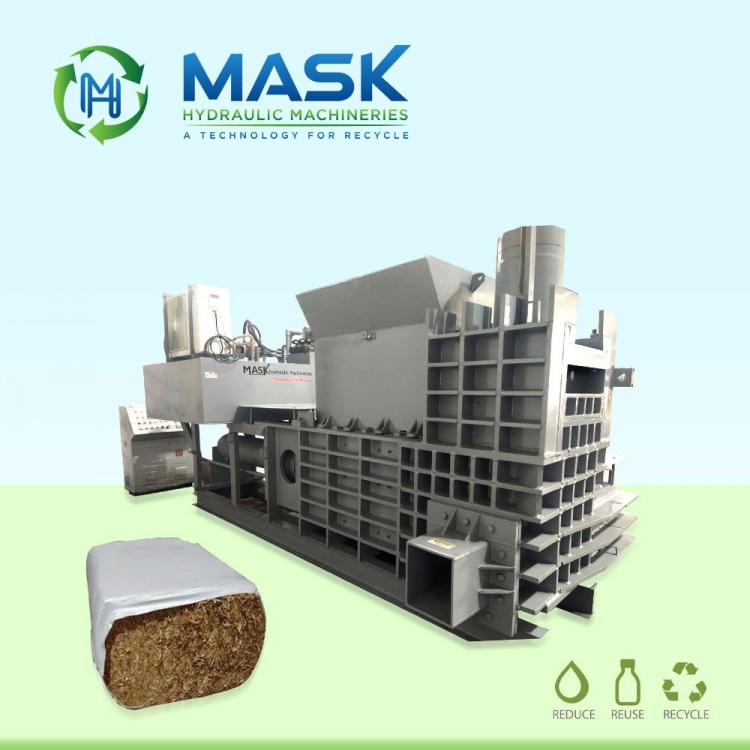
If you’re running a warehouse or a recycling plant, choosing a baler is one of the most essential purchases; it’s about how smoothly your floor operates every day. The right machine improves efficiency, reduces storage space, lowers transport costs, and increases material value. This article explains what you need to check before investing in a Baling Press Machine.
1. Identify the Type of Material You Handle
1. Know Your Waste Profile
Don't just look at the volume; look at the "type" of your trash. Ask yourself:
- What type of waste is it? Are we talking about cardboard, plastic films, or heavy metal pieces?

- How heavy is it? Light, airy foam needs a different touch than dense, heavyweight textiles.
- Is it messy? If your material is wet or holds moisture, a standard machine might rust or slip.
2. Choose Between Vertical and Horizontal Models
Vertical Baling Press Machine
- Occupies less floor space
- Suitable for low to medium waste volume
- Lower investment cost
- Manual feeding

Best for small warehouses, retail units, and packaging units.
Horizontal Baling Press Machine
- Handles large waste volumes
- Suitable for continuous operation
- Higher output
- Can be semi-automatic or fully automatic
3. Check Production Volume and Capacity
Capacity planning is important.
Ask yourself:
- How many kilograms of waste are generated daily?
- Is production expected to increase?
- Do you require continuous operation?
Capacity guidance:
- Low volume (small shops, retail units): If your waste generation is limited to cardboard cartons, packaging material, or light plastic, a vertical baler is usually enough. It is compact, easy to operate, and cost-effective. For small businesses, this type of setup handles daily waste without taking up too much floor space.
- Medium volume (factories, warehouses): Factories and warehouses usually produce steady waste throughout the day. A mid-range hydraulic baling press machine offers better compression force and faster cycle time. It helps manage continuous waste flow without slowing operations.
- High volume (recycling plants): Large recycling units and industrial plants require machines that can run for long hours and handle bulk material. A heavy-duty horizontal baler is designed for high output and consistent performance.
Avoid buying a machine that is either too small or too large.
4. Review Hydraulic Pressure and Motor Power
The Three Main Parts
- Pressure: This is how hard the machine pushes. It is usually measured in tons. The more tons it has, the tighter it can pack your waste.
- Motor Power: This is measured in HP or kW. In a baling press machine, a strong engine keeps the machine running all day smoothly without getting tired.
- Cycle Time: This is how many seconds it takes to squash one pile of waste. A faster machine means your team gets more done in less time.
5. Consider Automation Level
Automation plays an important role in how smoothly your operation runs. The more automated your system is, the less manual effort is required from workers. This improves speed, reduces fatigue, and keeps output consistent throughout the day.
Options available:
- Manual tying system: In this setup, the operator manually ties the bale after compression. It is suitable for small businesses with limited waste volume. It costs less but requires more labour and time.
- Semi-automatic operation: Here, the machine performs most of the compression process automatically, but some manual work is still required. It offers a good balance between cost and productivity. Many medium-scale businesses prefer this option.
- Fully automatic system: A fully automatic machine handles feeding, compression, tying, and bale ejection with minimal human involvement. It is ideal for high-volume operations where speed and consistency are important.
If your operation runs long hours daily, automation reduces labour costs and increases output consistency.
Conclusion
Ultimately, choosing the right baling press machine is about more than just moving trash; it’s about finding a reliable machine that keeps your floor clear and your costs down. You need a machine that handles your daily volume without constant problems or unexpected repairs. By prioritising the build quality and operator safety, Mask Hydraulic Machineries helps you turn a messy chore into a streamlined, value-driven process. It’s an investment that simplifies your workflow and builds a more efficient future for your entire team.
FAQ’s
- What size machine actually makes sense for a small business?
If you’re a smaller shop dealing mostly with cardboard boxes or light plastic wrap, a vertical baler is usually your best bet. Baling press machines have a small footprint, so they won't eat up your floor space, and they provide more than enough "squish" to keep your back area tidy without breaking the bank.
- How much pressure do I really need?
It all depends on what you’re throwing at it. Cardboard is relatively easy to compress, so you don't need a monster machine. However, if you’re baling springy materials like plastic jugs or scrap metal, you’ll need a machine with much higher hydraulic force to ensure the bales stay tight and don't pop open.
- How often do I need to worry about maintenance?
For the heavy lifting, like checking hydraulic fluid and structural welds, checking once a month is the industry standard to keep things running safely.
- Can I use one machine for different types of waste?
You can, but there’s a catch. While many balers from Mask Hydraulic Machinery are versatile, different materials behave differently under pressure. You might need to adjust the settings or cycle times to get a dense bale. If you’re switching between cardboard and heavy plastic constantly, just keep an eye on how the machine handles the tension.
- How long will a good baler actually last?
If you buy a quality machine and don’t skip out on your oil changes and inspections, these units are real workhorses. It’s not uncommon to see a well-maintained industrial baler still crushing it ten to fifteen years down the line. It’s all about how well you treat the hydraulics.





