
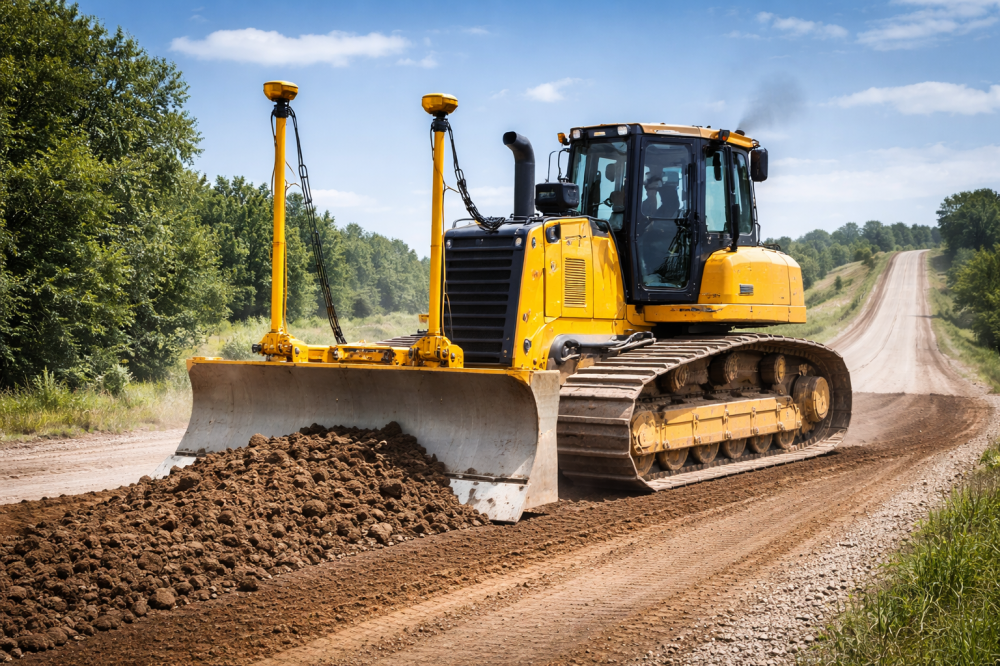
Road safety depends on construction quality. Thus, road construction needs immense precision. You may think heavy machinery can move dirt easily. However, achieving that perfectly level surface is all about sound engineering. Traditionally, operators relied mainly on manual stakes and eyesight to estimate grades.
Cut to the modern era, and crawler bulldozers have changed the dynamics. These are machines that let you achieve precision surface levels meeting engineering tolerances. Precision in grading is not something you can take lightly. It is a calculated process involving stability, hydraulic power, and integrated technology.
Why Stability Matters- How Track Designs Help You Get It Right
A bulldozer's physical build is the biggest benefit here. The track-type design offers a steady base, unlike wheeled machines that might bounce or dip. You need this kind of stability when the margin for error is only a few millimetres. The heavy undercarriage plays a major role. It keeps the machine pressed to the earth. This design ensures that the blade stays exactly where you set it.

Spreading the Weight to Keep Your Surface Smooth
A crawler bulldozer features a wide footprint. This is vital for surface uniformity. When you drive over soft soil, a wheeled vehicle often sinks or creates ruts. Tracks distribute the machine's weight over a larger area. This prevents the "washboarding" effect, where the ground becomes wavy. Because the machine doesn't sink, your blade remains at a constant height. You can glide over soft pockets of earth without losing your level.
Low Balance Points for Better Blade Control
The low centre of gravity in these machines is essential or accuracy. It provides a stable platform that resists the "pitching" motion. When a machine pitches forward or backward, the blade either digs too deep or lifts too high. This often leads to over-excavation. Using a bulldozer with a heavy, low-slung undercarriage minimises these movements. You gain better control over the road base preparation. It makes your job much easier.
Better Grading Quality through Fast Hydraulic Response
Modern hydraulic systems are incredibly sensitive. They allow you to make minute blade adjustments that were impossible decades ago. We are talking about millimetre-level precision. This is essential when you are working on the final finish grade of a highway. The speed at which the blade responds to your input determines how smooth the final path will be.
- Load-sensing hydraulics maintain constant blade pressure
- The system automatically adjusts to varying soil densities
- You get consistent power even when the dirt gets heavy
- Quick response times prevent gouging the surface
Using Blade Versatilely for Complex Roads
Roads are rarely flat. They have curves, crowns, and drainage slopes. You need a blade that can do more than push forward. The versatility of modern bulldozer blades allows you to tackle these complex profiles with ease.
How Does the Six-Way Blade Movement Help You Angle Better?
The Power Angle Tilt blade is a standout feature. It lets you angle, tilt, and lift the blade simultaneously. You can create precise crowns in the centre of the road in a single pass. You can also cut drainage slopes or super-elevations on corners without repositioning the entire machine. This saves time. It also ensures the slope is uniform from start to finish.
The blade's curvature is designed for soil retention. It influences the "roll" of the dirt. When dirt rolls properly in front of the blade, it stays contained. It prevents spill-off. If dirt spills off the sides, it creates irregularities in your grading path. A well-designed bulldozer blade keeps the material moving forward. This creates a cleaner, more accurate cut every time.
Grade Control Technologies
Technology has turned the bulldozer into a high-tech tool. You no longer have to jump out of the cab to check grade stakes every five minutes.
Getting High Precision with GNSS & Lasers
Crawler bulldozers serve as the main interface for 2D and 3D grading systems. These systems use GNSS or lasers to track the machine's position. The computer automatically adjusts the blade based on a digital site plan. This removes human error from the equation. Even if you are a less experienced operator, the technology ensures you hit the target grade perfectly.
Using Real-Time Data & Sensors
Onboard sensors continuously run in the background. They compensate for the machine's chassis tilt. If the tracks hit a bump, the sensors tell the blade to stay level. This ensures the road cross-slope remains consistent with the engineering blueprint. You get real-time feedback on your dashboard. It tells you exactly how much dirt you need to move to reach the finish line.
Why Smart Material Management Results in Accurate Grading?
Managing material is about more than just pushing it. It is about how you handle the machine during a turn. The "power-turn" capability is a major plus. This feature delivers power to both tracks even while you are turning. It allows you to maintain a steady grade on curved sections of the road. You won't lose momentum. You won't create deep ruts that ruin your accuracy.
How Does Your Comfort in the Cab Impacts the Final Grade?
If you are tired or vibrating in your seat all day, your accuracy will drop. It is a simple fact. Reduced vibration & intuitive joystick controls make a massive difference. Suppose the controls feel natural. Then you can make those tiny adjustments more effectively. Physical comfort keeps your mind sharp. This helps you maintain accuracy during the final hours of a long shift.
How to Ensure Precise Grading?
Precise grading is not only about looks. It is also about life on the road. The asphalt won't last if the base is not right.
Cutting Down on Material Waste
Accurate grading saves money. When you get the sub-base perfectly level, you don't need to add extra asphalt to fill low spots. Asphalt is expensive. Using a bulldozer to hit the exact grade prevents overapplication of costly base materials.
Improved Drainage for Longer Road Life
A good grade always results in more durable roads. A perfectly graded base prevents water from pooling under the pavement. Constant water exposure can be bad for any road. The water runs off as intended if you use a crawler bulldozer to create the right slopes. This prevents cracks as well as potholes from forming later.
How to Pick The Right Bulldozer for Your Job?
Not every machine fits every site. You must match the machine size to your soil type. If you are working on very soft ground, you might need a Low Ground Pressure configuration. If the ground is rocky and hard, an Extra Long track frame might be better. Choosing the right setup ensures the track's grip properly. Better grip leads to better accuracy.
Closing Thoughts
Good roads begin with proper grading. A crawler bulldozer gives you the stability and control needed to prepare a solid base. When the surface is level and shaped correctly the pavement performs better and lasts longer. Using the right machine for the job reduces rework and saves material. In the end precise grading is not about speed. It is about building a foundation that supports safe and durable roads for years.
FAQs
How do tracks help with grading accuracy?
Tracks provide a much larger surface area than tyres. This stops the machine from sinking into soft spots. You get a much steadier platform for the blade. Your grading remains consistent because the machine stays level. You can avoid the wavy patterns often left by smaller, lighter equipment.
What is a PAT blade on a bulldozer?
A PAT blade stands for Power Angle Tilt. It lets you move the blade in six directions. You can lift it, tilt it left or right, and angle it. This is why you can create complex road shapes & drainage slopes so accurately.
Why is grade control technology used in roadwork?
Grade control uses satellites or lasers to guide the machine. It communicates directly with the bulldozer's hydraulics to automatically move the blade. This ensures you follow the site plan exactly. It reduces rework and prevents you from wasting expensive materials, such as gravel or asphalt.





