

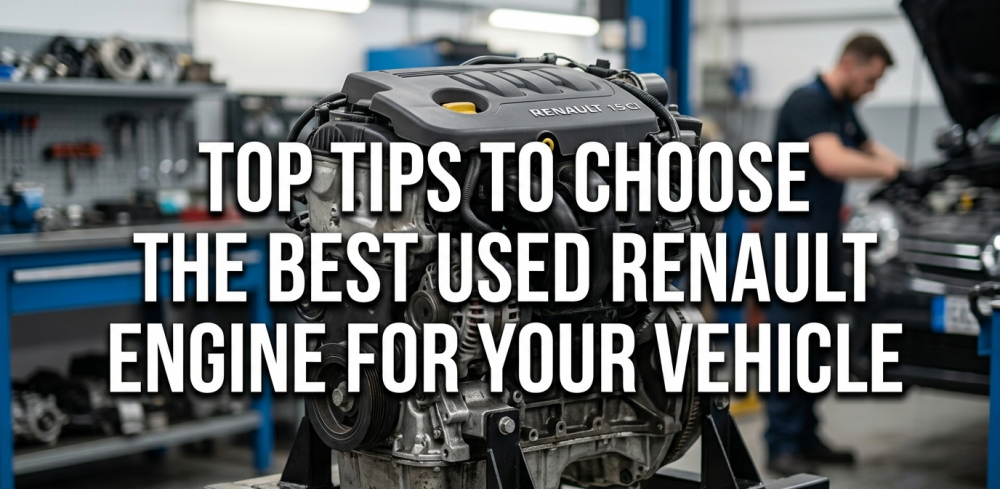
When your vehicle’s engine starts failing, replacing it with a used Renault engine can be a cost-effective and practical solution. However, making the right choice requires careful evaluation, technical understanding, and attention to detail. Below are the most important tips presented in a clear, structured format to help you make the best decision.
Tips to Choose the Best Used Renault Engine for Your Vehicle
Tip 1: Understand Your Vehicle’s Exact Engine Requirements
Before purchasing any engine, you must identify your vehicle’s exact specifications. Renault offers multiple engine variants across different models and years, so even a minor mismatch can cause serious compatibility issues. Check your VIN, engine code, fuel type, and transmission compatibility. This step ensures that the replacement engine fits perfectly and functions without complications. Skipping this step can lead to costly adjustments and performance problems later.
Tip 2: Always Check Engine Compatibility
Compatibility is not just about physical fit—it also includes electronic integration. Modern Renault vehicles rely heavily on sensors and ECUs, so the engine must match your vehicle’s system. If the electronics are not aligned, you may face warning lights, reduced performance, or even failure to start. Ensuring compatibility upfront saves both time and money.

Tip 3: Inspect the Engine Condition Carefully
The overall condition of the engine determines its reliability. A good Used Renault Engine should be clean, free from excessive rust, and show no signs of cracks or oil leaks. Visual inspection is crucial, but it should also be supported by technical testing. Pay close attention to any unusual wear, as it may indicate deeper internal issues.
Tip 4: Review Compression Test Results
Compression testing is one of the most important checks when buying a used engine. It reveals the internal health of the cylinders. Consistent compression across all cylinders indicates a well-maintained engine, while uneven readings may suggest internal damage. Always ask for test reports or proof of inspection before making your purchase.
Tip 5: Consider Mileage but Don’t Rely on It Alone
Mileage is an important factor, but it should not be the only one. A low-mileage engine may still have issues if it was poorly maintained, while a higher-mileage engine can perform well if properly serviced. Look at the overall condition and maintenance history instead of focusing only on numbers.
Tip 6: Ask for Maintenance and Service Records
Service history provides valuable insight into how the engine was treated. Regular oil changes, timely repairs, and proper servicing indicate responsible ownership. An engine with complete records is usually a safer choice compared to one with no documentation.
Tip 7: Choose a Reputable Seller
The seller plays a major role in your buying experience. Always choose a trusted supplier who specializes in used engines. Reliable sellers provide transparent details, proper testing, and customer support. Avoid unknown or unverified sellers offering extremely low prices, as they often come with hidden risks.

Tip 8: Look for Warranty Coverage
A warranty gives you peace of mind and protects your investment. Many reliable sellers offer warranties ranging from a few months to several years. Carefully read the terms and conditions to understand what is covered. A warranty-backed engine is always a better option than one sold “as-is.”
Tip 9: Understand What’s Included with the Engine
Used engines can come in different configurations, such as long blocks or complete assemblies. Some may include components like injectors, manifolds, or alternators, while others may not. Clarify what is included so you can estimate additional costs and avoid surprises during installation.
Tip 10: Get a Professional Inspection
If you are not an expert, involving a mechanic is a smart move. A professional can assess the engine’s condition, confirm compatibility, and identify potential problems. This small investment can save you from making an expensive mistake.
Tip 11: Check for Proper Storage Conditions
Engines that are stored correctly are more likely to perform well. Poor storage can lead to corrosion, dried seals, and internal damage. Make sure the engine has been kept in a clean and dry environment to maintain its quality.
Tip 12: Verify Testing and Certification
A tested used Renault Engine is always a safer option. Reputable sellers conduct tests such as leak-down and compression checks to ensure performance. Ask for certification or proof of testing before finalizing your purchase.
Tip 13: Compare Prices Wisely
While saving money is important, choosing the cheapest option can be risky. Compare engines based on condition, mileage, warranty, and seller reputation. Paying slightly more for a quality engine can save you from expensive repairs later.
Conclusion
Choosing the right Used Renault Engine requires careful evaluation of compatibility, condition, and seller reliability. By following these tips, you can avoid common mistakes and make a smart investment that restores your vehicle’s performance. When you choose trusted suppliers like Turbo Auto Parts, you gain access to quality-tested engines and dependable service. Turbo Auto Parts ensures reliability, proper inspection, and customer satisfaction, making your engine replacement process smooth and stress-free.
Read Also: What to Check Before Buying a Used Workhorse Engine in 2026





