

Every B2B sales team knows the frustration. Your marketing tool flags a hot account. Your CRM shows a recent email open. LinkedIn tells you someone just engaged with your competitor's post. But these signals live in separate places — and by the time your team connects the dots, the buyer has already moved on.
This is exactly where the gap between Intent Data vs GTM Execution hurts most. You have the data. You just can't act on it fast enough.

AI is changing that — not by adding more tools to your stack, but by finally connecting the ones you already have.
What Are "Scattered Signals" and Why Do They Kill Pipeline?
Buying signals are everywhere. A prospect downloads your whitepaper. A target account gets a new round of funding. A decision-maker visits your pricing page three times in a week. Each of these moments matters — but most sales teams never see the full picture because signals are spread across:
- CRM platforms
- Email and LinkedIn engagement tools
- Website analytics
- Third-party intent data providers
No single person can monitor all of these in real time. And when signals go unnoticed, pipeline opportunities simply disappear.

How AI Orchestration Brings It All Together
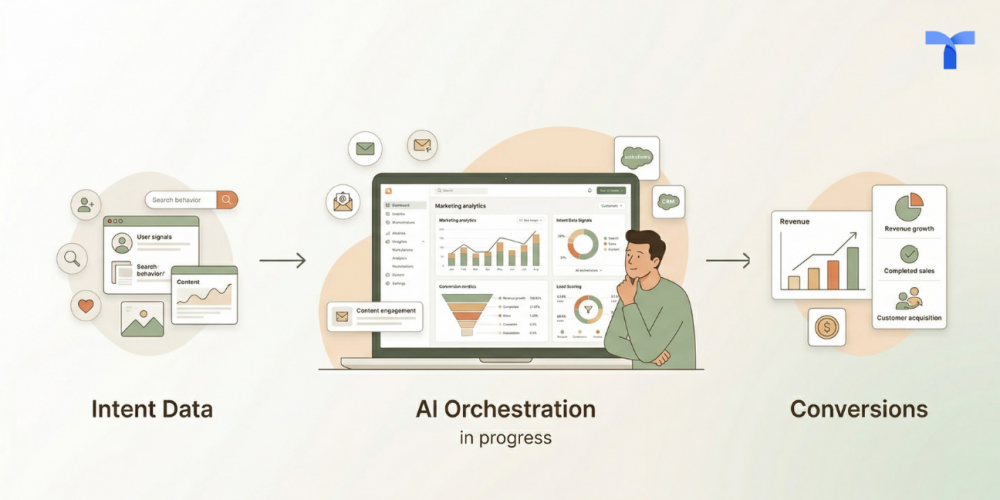
AI-powered signal orchestration solves this by acting as a central brain across your entire GTM stack. Instead of your team manually pulling reports from five different platforms, AI continuously monitors every channel, scores incoming signals based on relevance, and triggers the right action — automatically.
Here's what that looks like in practice:
1. Signal Collection Across Every Channel AI pulls data from your CRM, marketing automation platform, social channels, and third-party intent providers into one unified view. It doesn't matter where the signal originates — AI catches it.
2. Context-Aware Signal Scoring Not every signal is equal. AI weighs signals based on factors like account fit, buying stage, and historical behavior. A pricing page visit from a VP at a $50M company means something very different than the same visit from a student researcher.
3. Automated Action Triggering Once a signal crosses a threshold, AI doesn't wait for a human to act. It can enrich the contact record, alert the right rep, personalize an outreach sequence, or update the account stage — all within minutes of the signal firing.
This is where B2B lead generation moves from reactive to predictive. Instead of chasing leads that went cold, your team is reaching the right buyer at the exact right moment.
The Role of Clean Data in Signal Accuracy
AI orchestration is only as good as the data feeding it. This is why CRM data enrichment plays such a critical role in the process. Outdated contacts, missing job titles, and wrong company details don't just slow your team down — they actively mislead your AI models.
When your CRM is continuously enriched with fresh firmographic and behavioral data, your signal scoring becomes dramatically more accurate. AI can tell the difference between a cold account and one that's quietly showing five buying signals across three channels.
Clean data in. Reliable pipeline signals out.
From Signal to Conversation — At Scale
One of the biggest breakthroughs AI brings to signal orchestration is personalization at scale. Traditionally, a rep might have bandwidth to personally research and reach out to 10 accounts per week. With AI, that same rep can engage 10x the accounts with messaging that still feels researched, relevant, and human.
This is especially powerful when signals are layered — for example, combining a recent funding announcement with a job posting for a sales ops role and a LinkedIn comment on a competitor's content. AI connects these dots and helps craft outreach that speaks directly to what the account is experiencing right now.
Conclusion
Scattered signals don't have to mean a scattered pipeline. When AI brings your buying signals together — across your marketing automation platform, your CRM, your outreach tools, and your intent providers — your sales team stops guessing and starts acting with confidence.
The teams winning in B2B today aren't the ones with the most data. They're the ones who've built a system that turns every signal into a conversation, and every conversation into pipeline.





