
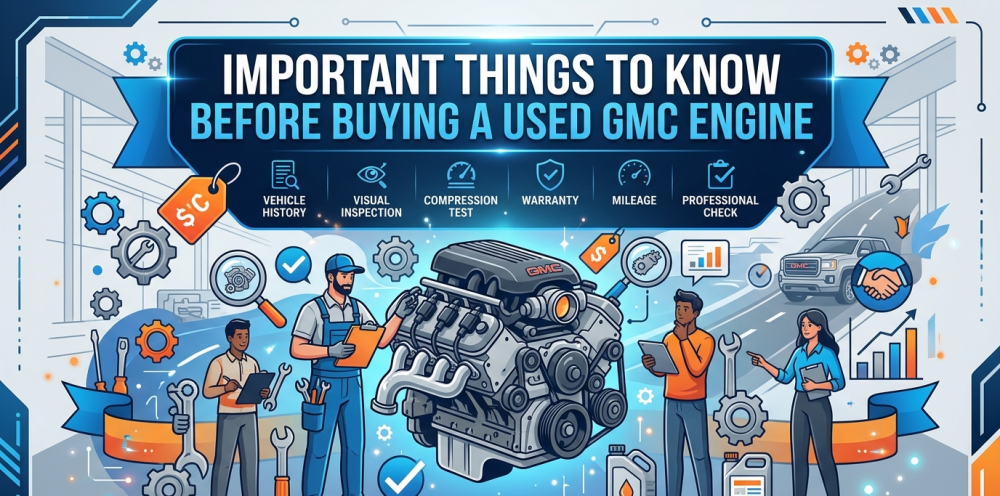
GMC trucks and SUVs are built to work hard. From the Sierra hauling trailers on the interstate to the Yukon carrying families across thousands of miles, GMC vehicles are engineered for durability and dependability. But even the toughest engines eventually wear out — and when the time comes for a replacement, navigating the used engine market can feel like a minefield. Buying a used GMC engine is one of the most significant mechanical investments you can make in your vehicle. Do it right, and you'll have a reliable powertrain that keeps your truck or SUV on the road for another 100,000 miles. Do it wrong, and you could be facing a repeat engine failure, wasted labor costs, and months of frustration.
This guide covers everything you need to know before making your purchase — from identifying the correct engine to vetting suppliers and understanding the true cost of ownership.
1. Know Your Engine Before You Shop
GMC has used a wide variety of engines across its lineup over the decades. Before you contact a single supplier, you need to know exactly which engine your vehicle requires. Using the wrong engine — even one that appears similar — can cause transmission incompatibility, ECU communication errors, and accessory mounting problems.

Here are some of the most common GMC engines you'll encounter in the replacement market:
- 5.3L Vortec V8 (LM7, LMG, LC9) – One of the most popular and widely available engines, found in the Sierra 1500, Yukon, and Envoy. Known for reliability and ease of sourcing.
- 6.2L V8 (L86, L87) – A high-output option found in the Sierra and Yukon Denali models. More powerful and more expensive to replace.
- 6.6L Duramax Diesel (LB7, LLY, LBZ, LMM, LML) – GMC's workhorse diesel, found in the Sierra HD and used extensively in commercial and towing applications.
- 4.3L Vortec V6 (LU3) – A budget-friendly option found in base-trim Sierra and Canyon models.
- 2.5L / 2.8L I4 (LCV, LWN) – Smaller engines found in the Canyon, including a diesel option.
Your vehicle's engine code can be found on a sticker under the hood, in the owner's manual, or decoded from the 8th character of your VIN number. Always cross-reference this with a parts specialist before purchasing, as even minor variations between model years can affect fitment.
2. Understand the Different Types of Used Engines
Not all used engines are the same, and understanding the distinctions will help you set realistic expectations for cost, reliability, and longevity.
Pull-Out (Salvage) Engines
These are engines removed from vehicles at salvage yards — typically cars or trucks that were totaled in accidents but had functional powertrains. Mileage can vary widely, from under 30,000 to well over 150,000 miles. Salvage engines are generally the least expensive option, but they come with the least documentation and oversight.

Low-Mileage Import Engines
Some suppliers import engines from overseas markets — particularly Canada and Mexico — where vehicle turnover may result in lower-mileage powertrains becoming available. This is less common with GMC engines than with Japanese imports, but it does exist for certain platforms.
Rebuilt Engines
A rebuilt engine has been disassembled, cleaned, and reassembled with a combination of new and reconditioned parts. The quality of a rebuilt engine depends heavily on the shop that did the work. Ask for documentation of what was replaced and what tolerances were measured.
Remanufactured Engines
Remanufactured engines are rebuilt to OEM specifications using standardized processes and components. They typically come with longer warranties and more consistent quality control than rebuilt engines. They cost more upfront but can be the most cost-effective option over the long term.
Knowing the difference allows you to compare apples to apples when evaluating quotes and make the choice that aligns with your budget and reliability expectations.
3. Verify Mileage with Compression and Leak-Down Tests
Mileage is the most commonly advertised metric when selling a used engine, but it's also one of the easiest to misrepresent or misunderstand. A used GMC engine with 75,000 miles from a vehicle that regularly towed heavy loads could be in significantly worse shape than one with 100,000 miles from a lightly used commuter truck.
The most reliable indicators of engine health are:
Compression Testing A compression test measures the pressure in each cylinder, revealing the condition of the piston rings, cylinder walls, and valves. For most GMC V8 engines, healthy compression readings fall between 140–180 PSI, with all cylinders within 10% of each other. Cylinders that read significantly lower indicate internal wear or damage.
Leak-Down Testing A leak-down test takes the compression test a step further by pressurizing each cylinder and measuring how much air escapes — and from where. Air escaping through the intake suggests bad intake valves; through the exhaust indicates exhaust valve issues; through the oil filler cap points to worn rings; and into the cooling system is a strong indicator of a blown head gasket.
Oil Analysis Some higher-end suppliers provide oil analysis reports that screen for metal particles (indicating internal wear), coolant contamination (head gasket issues), and fuel dilution (injector problems or poor combustion). This data is invaluable for assessing an engine's true condition.
Always request this documentation in writing before finalizing your purchase. A reputable seller will provide it without hesitation.
4. Be Aware of Common GMC Engine Problems
Every engine family has its known weaknesses, and GMC's lineup is no exception. Knowing the common failure points for your specific engine helps you ask better questions and spot red flags early.
AFM Lifter Failures (5.3L and 6.2L V8)
One of the most widely discussed issues with GMC's Generation IV small-block V8 engines is Active Fuel Management (AFM) lifter failure. AFM is GM's cylinder deactivation system, designed to improve fuel economy by shutting down four cylinders under light load. Unfortunately, the AFM lifters — which collapse to enable cylinder deactivation — are prone to premature failure, often taking out the camshaft with them.
When sourcing a used 5.3L or 6.2L engine, always ask whether AFM components are intact and whether there is any history of lifter noise, oil consumption, or AFM-related repairs. Many savvy buyers and builders choose to delete the AFM system entirely during installation as a preventive measure.
Duramax Injector and Fuel System Issues
The 6.6L Duramax diesel, while an incredibly capable engine, has had well-documented injector problems — particularly in early LB7 engines, where injectors were internal to the valve covers and notoriously expensive to replace. Later generations improved on this, but fuel system health should be a top priority when evaluating any used Duramax.
Carbon Buildup (Direct Injection Engines)
Newer GMC engines that use direct fuel injection are susceptible to carbon buildup on the intake valves. Unlike port-injected engines, fuel never washes over the valves in a direct-injection system, allowing carbon deposits to accumulate over time. This can reduce airflow, cause rough idle, and hurt performance.
Coolant System Neglect
GMC's aluminum engine blocks and heads require specific coolant formulations (GM's DEX-COOL or an approved equivalent) to prevent corrosion. Engines that were run with incorrect coolant or that went long periods without coolant changes may have internal corrosion or silicone deposits that can clog passages and cause overheating.
5. Confirm Exactly What Is (and Isn't) Included
One of the most frustrating experiences in the used engine market is discovering after purchase that an engine doesn't include components you assumed were part of the sale. Before you commit, get a detailed, itemized list of every component included with the engine.
For a, this should ideally include:
- Intake manifold and throttle body – These are often removed and sold separately.
- Alternator, power steering pump, and A/C compressor – Accessory components vary by seller.
- Sensors – MAF sensor, MAP sensor, crankshaft and camshaft position sensors, and knock sensors are all critical for proper ECU communication.
- Flexplate or flywheel – Required for transmission mating.
- Wiring harness – Some sellers include a partial harness; others strip it entirely.
- Exhaust manifolds – Often removed or damaged in salvage situations.
For diesel engines, additionally confirm whether the turbocharger, EGR system components, and fuel injectors are included. These parts alone can represent thousands of dollars in replacement cost if not included.
Getting clarity on inclusions upfront prevents unpleasant surprises when the engine arrives and your mechanic starts the installation.
6. Research the Seller Thoroughly
The seller you choose matters just as much as the engine itself. In a market where online listings can be created by anyone with a phone and a salvage yard, doing your due diligence on the source of your engine is non-negotiable.
Here's how to evaluate a seller:
Check Reviews Across Multiple Platforms Look at Google reviews, Trustpilot, the Better Business Bureau, and automotive forums like GM-Trucks.com or Silverado Sierra forums. Pay attention to patterns — repeated complaints about misrepresented mileage, poor packaging, or unresponsive customer service are serious warning signs.
Ask About Their Testing Process Reputable suppliers test engines before listing them, either by running them briefly or performing compression tests. Ask specifically how each engine is evaluated and whether you can receive the test results.
Understand the Warranty Terms A seller who offers no warranty on a used engine should be viewed with skepticism. Standard industry warranties range from 30 to 90 days. Premium suppliers may1 year to 4 year. Read the fine print carefully — some warranties exclude labor costs, which can be substantial if an engine fails after installation.
Look for Specialty Expertise Suppliers who specialize in GM engines are more likely to know the common failure points, have properly inspected inventory, and provide accurate compatibility guidance. A general junkyard that also happens to sell engines is a very different proposition from a dedicated engine specialist.
7. Plan for Additional Installation Costs
The purchase price of a used GMC engine is only part of the financial picture. A realistic budget must account for all associated costs, including:
- Labor – Professional engine installation on a GMC V8 typically runs between $1,200 and $3,000 depending on location, shop rates, and engine complexity. Diesel swaps can cost significantly more.
- Gaskets and Seals – A full gasket kit, including head gaskets, valve cover gaskets, and intake manifold gaskets, should always be replaced during installation.
- Timing Chain Components – On high-mileage engines, it's wise to replace the timing chain, guides, and tensioner at the time of installation.
- Fluids – Fresh engine oil, coolant, and (for diesel engines) DEF fluid.
- Spark Plugs and Ignition Components – Gasoline engines should receive a fresh set of spark plugs and, if needed, coil packs.
- AFM Delete Kit – If you're swapping in a 5.3L or 6.2L with AFM, many experienced shops recommend deleting the system outright during installation to avoid future lifter failures.
Building these costs into your initial budget prevents sticker shock down the road and ensures the job gets done properly from the start.
8. Match the Engine to Your Vehicle's Purpose
This may seem obvious, but it's worth emphasizing: the best engine for your truck depends heavily on how you use it.
If you're replacing the engine in a work truck that primarily hauls and tows, you want an engine with strong low-end torque and proven reliability under sustained load — the 5.3L Vortec or a properly sourced Duramax diesel are natural fits.
If you drive a Denali-trim Yukon and want to preserve the premium driving experience, matching the original 6.2L is the right call. Swapping down to a smaller engine may save money initially but will affect performance, fuel economy calculations (if the ECU is tuned for the larger engine), and resale value.
Performance enthusiasts building a project Sierra or Canyon may want to consider a higher-output variant even if it wasn't the original engine — but these swaps require additional planning around transmission compatibility, computer calibration, and exhaust systems.
Conclusion
Buying a used GMC engine is a major decision that deserves serious research, careful vetting, and a clear understanding of the total investment involved. From verifying the correct engine code to inspecting compression test data, understanding common failure points, and choosing a reputable supplier, every step of the process matters. GMC's lineup of V8 and diesel engines is among the most capable and widely supported in the automotive world — which means quality replacement options exist if you know where to look. That's where a trusted name like Turbo Auto Parts makes all the difference. Whether you're sourcing a Vortec small-block for a workhorse Sierra or a Duramax diesel for heavy-duty duty cycles, Turbo Auto Parts backs every engine with the kind of expert guidance, tested inventory, and reliable warranties that take the guesswork out of the process.
The principles remain the same: verify condition, understand inclusions, vet the seller, and plan for total installation costs. Take your time, ask the hard questions, and don't let an attractive price tag override the fundamentals. A properly sourced engine, correctly installed, will serve you faithfully for years to come.
Frequently Asked Questions (FAQ)
How do I find the correct engine code for my GMC vehicle?
The easiest method is to decode your VIN number — the 8th character identifies the engine type. You can also find a sticker on the engine block itself or consult your owner's manual. When in doubt, provide your full VIN to a reputable engine supplier and they can confirm compatibility.
Is a rebuilt GMC engine better than a used pull-out engine?
It depends on your priorities. A rebuilt engine offers more predictable reliability and typically comes with a better warranty, but it costs more. A quality pull-out engine with low mileage and clean compression test results can be just as reliable at a lower price point. Evaluate both options based on documented condition, not price alone.
What mileage is too high for a used GMC engine?
There's no universal cutoff, but most buyers prefer engines under 100,000 miles for gasoline V8s and under 150,000 miles for Duramax diesels (which are built to higher durability standards). Mileage should always be evaluated alongside compression test data and maintenance history — condition matters more than odometer numbers alone.
How long does it take to install a replacement GMC engine?
A professional shop typically needs two to four days for a standard V8 swap, depending on vehicle complexity and parts availability. Diesel swaps or installations involving AFM deletion, custom wiring, or ECU recalibration can take longer. Plan for your vehicle to be out of service for at least a week to allow time for parts arrival and any unexpected complications.
Should I delete the AFM system when installing a replacement 5.3L or 6.2L engine?
Many experienced GMC mechanics strongly recommend it. The AFM lifter system is a known weak point in Gen IV small-block V8s, and disabling it during a fresh engine installation adds minimal cost but potentially prevents a very expensive failure down the road. An AFM delete typically involves installing a replacement camshaft, solid lifters, and a tune to disable the cylinder deactivation system in the ECU.
Read Also: Is It Safe to Buy a 2011 GMC Acadia Engine Online Today?





