
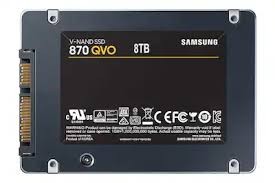
There was a time, not so long ago, when "8 terabytes" was a number reserved exclusively for massive, humming server racks or external hard drive enclosures the size of a toaster. If you wanted that much space, you had to accept the mechanical "click-whirr" of spinning platters and the agonizingly slow data transfer speeds that came with them.
In 2026, the narrative has shifted completely. The 8TB Solid-State Drive (SSD) has moved from a niche, ultra-luxury item to the gold standard for power users, creative professionals, and gamers who refuse to play the "uninstall game" dance every time a new patch drops.
Why 8TB? The Death of "Storage Anxiety"
We live in an era of data inflation. A single AAA game title can now easily clear 300GB. Professional videographers are shooting in 8K RAW, where a few minutes of footage can gobble up dozens of gigabytes. Even the average family photo library, filled with high-resolution bursts and 4K cinematic clips, is outgrowing the standard 1TB or 2TB drives that were common just a few years ago.

An 8TB SSD isn't just about "more space"; it’s about digital freedom. It’s the ability to keep your entire project history, your full gaming library, and your OS on a single, lightning-fast volume.
NVMe vs. SATA
When shopping for an 8TB drive today, you’ll generally encounter two main form factors:
1. NVMe M.2 (The Speed King)
These are the small, stick-shaped drives that plug directly into your motherboard. By 2026, PCIe Gen5 and Gen6 interfaces have pushed these drives to mind-bending speeds. We are talking about sequential reads of over 10,000 MB/s. For a video editor, this means scrubbing through a timeline of 8K footage feels as smooth as scrolling through a text document.
2. SATA 2.5-inch (The Bulk Storage Specialist)
While slower than their NVMe cousins, the 2.5-inch SATA SSD is still a beloved workhorse. It’s the perfect replacement for old mechanical hard drives. If you have a massive library of media that doesn't require instantaneous load times—like a Plex server or a photo archive—the SATA 8TB SSD offers a more stable, cool-running, and often more affordable solution.
The Benefits Beyond Just "Fast"
While "speed" is the headline, the real-world benefits of a high-capacity SSD are more nuanced:

-
Silence and Durability: Unlike HDDs, SSDs have no moving parts. This means your high-end rig stays silent, and if you happen to bump your laptop or drop your external drive, your data isn't at the mercy of a fragile mechanical arm.
-
Energy Efficiency: 8TB SSDs consume significantly less power than a multi-drive HDD array. In a world where energy costs and thermal management are top of mind, a single high-capacity SSD keeps your system running cooler and longer.
-
Reduced Complexity: Why manage four 2TB drives and deal with complex RAID configurations or multiple drive letters (D:, E:, F:, G:) when you can have one massive, unified C: drive?
Who is the 8TB SSD for?
In 2026, this drive is no longer "overkill" for everyone.
-
The Content Creator: If you’re a YouTuber or a 3D artist, an 8TB NVMe drive is your primary scratch disk. It allows you to store multiple active projects without the bottleneck of external cables.
-
The "All-In" Gamer: With game sizes ballooning, an 8TB drive allows you to keep your entire Steam, Epic, and Game Pass library installed simultaneously. No more waiting three hours for a redownload when a friend asks you to jump into a match.
-
The AI Enthusiast: With local LLMs (Large Language Models) and generative AI tools becoming common, users need massive amounts of fast storage to hold local datasets and model weights.
The Cost Factor: Is It Worth It?
Let’s be honest: 8TB SSDs still carry a premium. However, the "cost per gigabyte" has plummeted over the last decade. When you factor in the time saved on data management, the lack of mechanical failure risks, and the sheer performance boost, the ROI (Return on Investment) for a professional is undeniable.
Conclusion
The move to 8TB is more than just a spec bump; it is a fundamental change in how we interact with our computers. We are moving away from the era of "managing" storage and into an era of simply "using" it. Whether you are building a cutting-edge workstation or upgrading a high-end gaming PC, the 8TB SSD is the ultimate foundation.
As data centers and home labs continue to evolve, staying updated on the best ways to manage these massive storage volumes is essential. For those looking to master their digital infrastructure and stay ahead of the next wave of hardware, keeping an eye on server tech central is the best way to ensure your data stays fast, safe, and accessible for years to come.





