

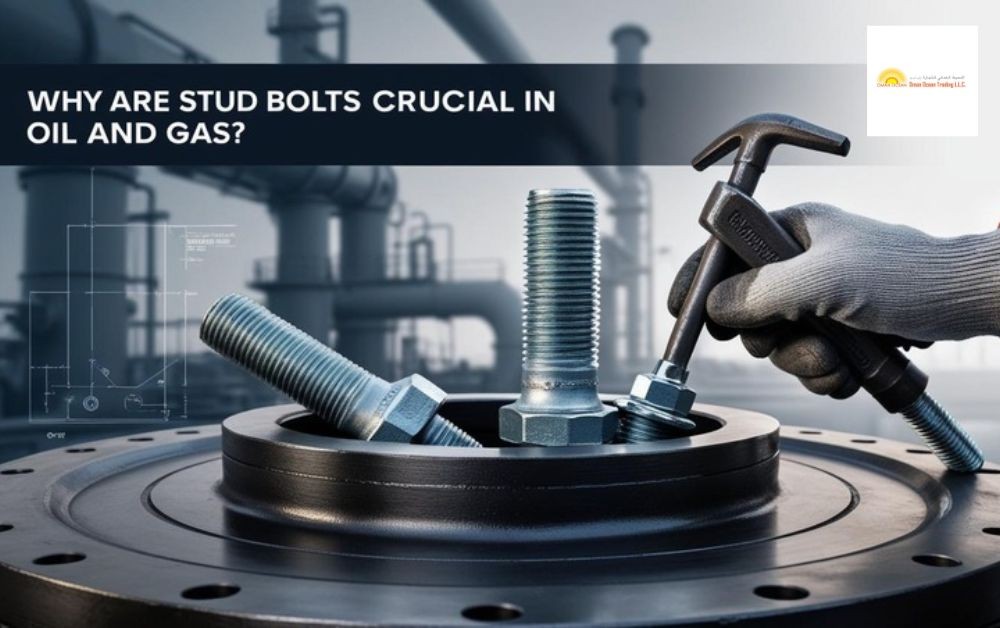
In the oil and gas industry, where operations occur under extreme pressure, temperature, and environmental conditions, the reliability of every component is non-negotiable. Among the essential elements used in critical infrastructure are stud bolts—fasteners that, although small in size, play a pivotal role in ensuring safety, structural integrity, and operational continuity.
This article explores why stud bolts are indispensable in oil and gas applications, examining their functions, benefits, material considerations, industry standards, and the implications of failure in this high-risk sector.
Understanding the Function of Stud Bolts
Stud bolts are threaded rods, typically without a head, used with two heavy hex nuts on either side to secure flanged connections. In oil and gas operations, these fasteners are extensively used in high-pressure pipelines, valves, pressure vessels, heat exchangers, and subsea equipment.

Stud bolts ensure tight, reliable joints between components that transport volatile substances such as crude oil, natural gas, and refined fuels. The performance of these connections directly affects the safety and efficiency of the overall system.
Importance of Flanged Connections in Oil and Gas
The oil and gas sector relies heavily on flanged joints, especially in piping systems and pressure equipment. Flanges allow for easy assembly, disassembly, inspection, and maintenance, which is crucial in large-scale, high-stakes operations.
However, the integrity of these flange joints hinges on the fastening system, with stud bolts serving as the primary load-bearing element. Improperly selected or poorly maintained stud bolts can compromise the entire joint, leading to leaks, equipment failure, or catastrophic accidents.
Handling High-Pressure and High-Temperature Conditions
Oil and gas facilities—especially those involved in upstream and midstream activities—often operate in high-pressure, high-temperature (HPHT) environments. Stud bolts in these applications must endure:
- Internal pipeline pressures that exceed 10,000 psi
- Temperatures above 400°C (752°F)
- Constant thermal expansion and contraction
- Exposure to corrosive and chemically aggressive media
Stud bolts are engineered from high-strength materials and subjected to rigorous heat treatment processes to withstand these demands. Without fasteners that match the strength and durability of the system, the risk of blowouts, equipment damage, or fire increases dramatically.

Ensuring Safety in Hazardous Environments

Safety is the foremost priority in oil and gas operations. Stud bolts play a critical role in sealing off hazardous substances and preventing gas leaks or oil spills. When flange connections are securely fastened with correctly rated stud bolts, they can resist vibration, pressure surges, and mechanical stress over long periods of operation.
Many safety incidents in the past have been linked to flange or gasket failure, often traceable to inadequate or corroded stud bolts. As a result, selecting the correct fasteners has become a fundamental part of any risk mitigation plan in the industry.
Material Selection for Stud Bolts in Oil and Gas
Stud bolts used in oil and gas are manufactured from materials that are capable of enduring harsh conditions, including exposure to seawater, hydrogen sulfide (H₂S), and high salinity. Material selection is guided by the specific environmental and operational requirements.
Common Materials for Stud Bolts
- ASTM A193 Grade B7: High tensile strength and heat resistance; suitable for high-temperature applications.
- ASTM A320 Grade L7: Designed for low-temperature applications, often used in cryogenic environments.
- Inconel and Hastelloy: Nickel-based alloys offering exceptional corrosion and oxidation resistance.
- Duplex and Super Duplex Stainless Steel: Provide strength and resistance to chloride stress corrosion cracking.
- Monel 400: Excellent in marine and chemical environments.
Each material comes with its own mechanical and chemical properties, which must be carefully matched to the application to prevent premature failure or corrosion.
Compliance with Industry Standards
Stud bolts used in oil and gas must meet stringent international standards to ensure consistent performance under critical conditions. Compliance is not optional—it is a necessity for safety, reliability, and regulatory approval.
Key Standards
- ASTM A193 / A194: Covers material requirements for stud bolts and nuts used in high-temperature and high-pressure services.
- ASME B16.5 and B16.47: Specifies flange dimensions and pressure ratings where stud bolts are installed.
- NACE MR0175 / ISO 15156: Outlines materials resistant to sulfide stress cracking in sour gas environments.
- API (American Petroleum Institute): Provides performance and testing standards for fasteners used in oilfield equipment.
Smart buyers in the oil and gas sector ensure that their fasteners are properly certified and documented for full traceability and quality assurance.
Resistance to Corrosion and Environmental Exposure
Corrosion is a persistent threat in oil and gas environments, especially offshore, where equipment is exposed to salt spray, seawater, and humidity. Stud bolts must be equipped with protective coatings or manufactured from corrosion-resistant alloys to withstand these harsh conditions.
Popular Coatings and Treatments
- Hot-Dip Galvanizing: Adds a zinc layer to protect against oxidation.
- PTFE (Teflon) Coating: Offers chemical resistance and reduces friction.
- Xylan Coating: Used for superior corrosion resistance and torque control.
- Cadmium or Zinc Plating: Traditional methods for moderate protection.
The correct coating not only enhances the lifespan of the stud bolt but also aids in easier installation and removal during maintenance.
The Role of Torque and Tension in Stud Bolt Performance
Achieving the right clamping force through proper torque application is essential for flange integrity. Over-tightening or under-tightening can lead to gasket damage, leaks, or bolt fatigue.
Modern oil and gas operators use torque wrenches, hydraulic tensioners, or ultrasonic bolt tension monitoring to ensure that each stud bolt is tightened to the precise specification. This reduces the risk of joint failure and improves safety.
Stud Bolts in Subsea and Offshore Installations
Subsea and offshore installations pose even greater challenges due to extreme pressure, zero accessibility, and aggressive environments. In these conditions, stud bolts must not only endure corrosion and mechanical stress but must also be maintenance-free for long durations.
Special grades like Inconel 718 or Super Duplex stainless steel are commonly used in subsea operations. Stud bolts are often pre-coated or encapsulated to resist corrosion for 20+ years under deep-sea conditions.
These fasteners are also subjected to non-destructive testing (NDT) methods, such as ultrasonic inspection or magnetic particle testing, to verify structural integrity before deployment.
The Cost of Failure and the Need for Precision
A single fastener failure in an oil and gas facility can result in:
- Equipment downtime costing thousands to millions of dollars per hour
- Environmental damage from leaks or spills
- Risk to human life
- Regulatory penalties and reputational loss
Therefore, every detail matters—from the metallurgy and dimensional accuracy of the stud bolt to the torque applied during installation. Precision and quality control are non-negotiable.
Advances in Manufacturing and Supply Chain
To meet industry needs, leading manufacturers are using CNC machining, heat treatment technologies, and advanced testing equipment to produce stud bolts with exceptional uniformity and durability. Digital supply chains now enable real-time tracking of production, certification, and delivery.
Ongoing innovation in material science and manufacturing is resulting in lightweight, high-strength, and corrosion-resistant fasteners tailored for specific applications.
Conclusion
Stud bolts are far more than just mechanical connectors in the oil and gas industry—they are critical safety components that ensure system integrity in high-risk environments. From upstream drilling rigs to downstream refineries, the performance of stud bolts directly affects operational safety, reliability, and cost-efficiency.
Their role in withstanding extreme pressure, resisting corrosion, maintaining joint integrity, and ensuring long-term durability makes them irreplaceable. Selecting the correct stud bolts—backed by proper material certification, coating, and installation techniques—is essential for any successful oil and gas operation.
As the industry continues to evolve with more complex and remote operations, the importance of these seemingly simple components will only grow. Engineering teams, procurement specialists, and maintenance crews must continue to give stud bolts the attention and investment they deserve.
For more insightful articles related to this topic, feel free to visit murfreesborovoice





