

In an increasingly connected world, reliable high-speed internet is no longer a luxury—it’s a necessity. From remote work and online education to video streaming and smart home devices, modern life depends on robust internet infrastructure. That’s where Fibre to the Home (FTTH) comes in. This next-generation technology offers ultra-fast, high-capacity internet by bringing fiber-optic cables directly to your residence. In this article, we’ll break down what FTTH is, how it works, and why it’s rapidly becoming the gold standard in home internet delivery.
What Is Fibre to the Home (FTTH)?
Fibre to the Home (FTTH) is a broadband network architecture that delivers optical fiber directly from a central point—such as a local exchange or data hub—to individual homes or buildings. Unlike older technologies that rely on copper wires or coaxial cables, FTTH uses thin strands of glass or plastic to transmit data as pulses of light. This allows for dramatically faster data transmission speeds, greater bandwidth, and increased reliability.
FTTH is a type of fiber-optic communication, and it falls under the broader category of Fibre to the Premises (FTTP). While FTTP can also refer to connections delivered to businesses or multi-dwelling units (MDUs), FTTH specifically targets individual residences.

How Does FTTH Work?
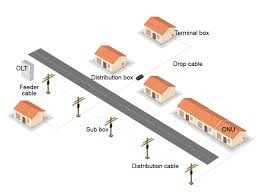
FTTH operates through a simple yet powerful structure that replaces traditional copper wires with fiber-optic cables. Here’s a step-by-step breakdown of how it works:
1. Central Office or Data Hub
At the heart of the FTTH network is a central office or service provider data hub, where all data originates. This facility is equipped with powerful servers and high-capacity networking equipment that manage the flow of digital content (internet, television, phone, etc.).
2. Optical Line Terminal (OLT)
Inside the central office, an Optical Line Terminal (OLT) converts digital signals into light pulses and sends them through fiber-optic cables toward residential areas.
3. Fiber Distribution Network
The light signals travel through a network of feeder and distribution fiber cables, typically installed underground or along utility poles. These cables connect to passive optical splitters, which divide the signal and distribute it to multiple homes.
4. Optical Network Terminal (ONT)
At each home, an Optical Network Terminal (ONT) is installed—usually mounted inside or outside the building. This device converts the light signals back into electrical signals that your router or modem can use to deliver internet, TV, and phone services.

5. Wi-Fi Router or Gateway
Finally, the ONT connects to a Wi-Fi router or gateway inside the home, enabling all your devices to connect wirelessly to the internet.
FTTH vs. Traditional Broadband
| Feature | FTTH | Cable/DSL |
|---|---|---|
| Speed | Up to 10 Gbps (or more) | Typically up to 1 Gbps |
| Reliability | Very high | Prone to signal degradation |
| Distance Limitations | Minimal | Degrades over distance |
| Bandwidth Sharing | Dedicated to each home | Shared with neighborhood |
| Future-Readiness | Highly scalable | Limited by legacy tech |
FTTH is superior in nearly every metric, especially when it comes to supporting modern bandwidth-intensive applications like 4K streaming, gaming, video conferencing, and smart home automation.
Key Advantages of FTTH
1. Lightning-Fast Speeds
FTTH offers symmetrical download and upload speeds that can exceed 1 Gbps. This is ideal for households with multiple users, online gamers, and remote workers who need to upload large files or stream in HD.
2. Exceptional Reliability
Fiber-optic cables are less susceptible to interference from weather, electrical noise, or physical wear and tear. FTTH networks are designed to deliver consistent performance, even during peak usage times.
3. Scalability
FTTH networks are future-proof. As new technologies and applications emerge, service providers can upgrade infrastructure without replacing the physical fiber. This means you can enjoy cutting-edge connectivity for years to come.
4. Low Latency
With minimal signal loss and nearly instantaneous data transfer, FTTH provides low latency—perfect for online gaming, real-time communication, and financial transactions.
5. Higher Property Value
Homes with fiber connections often enjoy higher resale values, as homebuyers increasingly prioritize fast, reliable internet access.
Is FTTH Available in Your Area?
Availability varies depending on your location. Urban and suburban areas are more likely to have established FTTH infrastructure, while rural areas may still be reliant on DSL, satellite, or wireless broadband. Many governments and telecom providers are investing heavily in expanding fiber networks to close the digital divide.
You can check with local internet service providers or municipal utility boards to see if FTTH is available in your area.
Conclusion
fibre to the home services (FTTH) is revolutionizing how we connect to the internet by providing unmatched speed, reliability, and scalability. As digital demands continue to grow—whether through remote work, smart homes, or streaming entertainment—FTTH stands out as the most robust and future-ready internet solution.
If you're considering upgrading your internet service, FTTH is an investment in performance, productivity, and peace of mind. It's not just the internet of today—it's the infrastructure of tomorrow.





