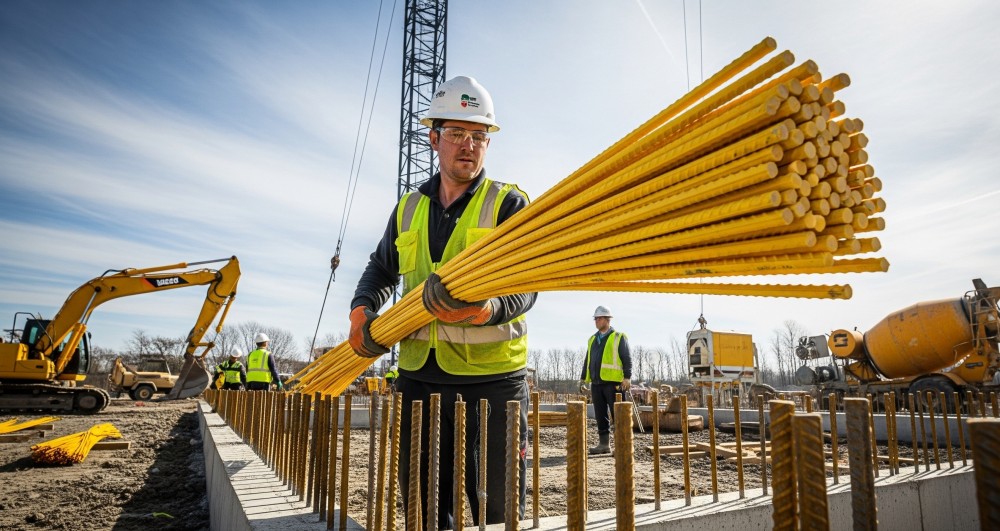
Have you ever wondered how construction materials are changing to address issues such as corrosion, maintenance, and cost issues? Among these innovations is the Fiber Reinforced Polymer (FRP) rebar- a robust, lightweight, and non-corrosive rebar that replaces the old steel in reinforcement. As its application expands due to the requirements in the challenging conditions like the coastal work, wastewater plant, and chemical structures, the pertinence of the standards and codes of its implementation is more crucial than ever.
FRP rebar is attracting attention in India without a detailed series of guidelines. Nevertheless, the continuous work of the Bureau of Indian Standards (BIS), along with the experience of other international codes, is opening the road to a safe and efficient use. We will discuss in this blog the government standards that come into play, how they are relevant to world practice, and what the contractors and engineers ought to remember when using FRP rebar.
Why is FRP Rebar a Game-Changer?
FRP rebar consists of a polymer matrix with the fibers (such as glass, carbon, and aramid). It cannot be corroded by moisture, salts, and chemicals, which are features of steel as compared to those of steel; hence, it is very effective in structures that are subject to extreme conditions. It is also lightweight and hence easy to transport and install, and its non-conductive qualities enable it to be used in sensitive electrical systems.

The application of FRP rebar has its limitations, though, regarding the mechanical behavior and anchorage technique, and compatibility with concrete structures. This is why standards and codes must be followed not only to comply, but to make the structure safe and stable.
Indian Standards Guiding the Use of FRP Rebar
Even though the standards regarding FRP rebar in India are currently developing, the current systems can be used to get some frames of concept regarding utilization.
- IS 15916:2020
This standard addresses durable concrete elements with regard to using durable materials. It also focuses on structural safety, maintenance friendliness, and environmental resistance, all of which at times FRP rebar can help in. These principles can be adapted to incorporate FRP reinforcement in projects that involve modular bridges, coastal walls, or water treatment facilities.
- IS 456:2000
This standard is broadly used in India and provides broad outlines in the design of structures. Although it is mostly concerned with steel reinforcement, its clauses on load-bearing capacity, factors of safety, and concrete strength can be applied to the FRP designs, given the necessary adjustments. When using this standard, engineers need to take into account the particular characteristics of FRP, including reduced elasticity and characteristic failure modes.
Draft BIS Standard for GFRP Reinforcement
Since formal guidelines are necessary, BIS is developing a draft specification that will be devoted to Glass Fiber Reinforced Polymer (GFRP) bars. This report is supposed to offer material property, design, and anchorage specifications and testing procedures that would suit the Indian climate, such as humidity on the coast, salt, and extreme temperature changes.

- IRC: SP 121-2018
Though this guideline is primarily related to such materials as copper slag, it represents a more general approach toward alternative and sustainable materials in the infrastructure project implementation. FRP rebar, boasting of its maintenance, saving, and corrosion resistance traits, can fit into this philosophy and can be marketed in rural roads, irrigation channels, and wastewater projects.
International Standards
As India continues to develop its own regulations, international standards provide tried and tested design and performance evaluation frameworks.
ACI 440.1R-15 - FRP Bars Guide on the Design and Construction of Concrete Reinforced.
This is a popular American Concrete Institute (ACI) guide that offers specific suggestions in choosing FRP bars, estimating load-bearing capabilities, and solving anchorage challenges. These guidelines can be applied together with IS 456 and IS 15916 and applied in coastal and chemical-degraded environments, whereby corrosion is a major issue of concern among Indian engineers.
ACI 440.3R-12 - Guide Test Methods FRP Reinforcing Bars
This manual gives standard test procedures to determine the tensile strength of FRP, bond behavior, and long-term durability. When testing on these lines, it is possible to ensure that FRP will reach anticipated performance before it is placed in the highly crucial structures. Indian laboratories can modify these protocols with already existing test techniques, such as IS 516:2018 - Methods of Test for Strength of Concrete, to determine the suitability of the material.
Indian Construction FRP Rebar Advantages
The benefits of the use of FRP rebar are particularly applicable in the diversified climate and infrastructural requirements in India:
- Corrosion Resistance - required in the coastal, marine bridges, and wastewater treatment facilities, where the traditional steel reinforcement wears out easily.
- Durability - Structures need fewer repairs, hence reducing the cost of repairs in the long run.
- Lightweight - Less handling and transport effort make it efficient at the site.
- Non-Conductive - Can be used in electrical facilities and hospitals with no disturbance to equipment.
- Large Strength-to-Weight Ratio - Provides sufficient reinforcement without a large increase in weight.
- Sustainability - Minimized environmental footprint of the construction projects is achieved through longer service life and reduced maintenance.
Although this has advantages, it is limited by some challenges to broader use:
- Greater initial Cost - FRP rebar costs more than steel, but costs can be saved through lifecycle savings.
- Absence of Awareness - A number of professionals do not know how to handle it or design the requirements.
- Design Complexity - The complexities involved in proper anchorage and spread of load must be planned well, and an expert must be involved.
You may read: Are Glass Fiber Reinforced Polymer Rebar the Future of Long-Lasting Structures?
Final Thoughts
FRP rebar is not a substitute only- it is a solution to the construction problems of the 21st century. It is also cost-effective in terms of corrosion resistance, lightweight design, and durability; hence, projects that cannot be supported by conventional reinforcement can be provided with long-term value. The best way to ensure safety, performance, and sustainability walk hand in hand is to harmonize and align Indian standards with international best practices.
With the growth of the infrastructure in India, the prudent and responsible use of FRP rebar will be very instrumental in the creation of sustainable and future-oriented buildings, which are very resilient in time, climate, as well as in the elements.
FAQs
- Can FRP rebar be applied in every kind of construction project in India?
FRP rebar is most applicable to facilities subject to moisture, chemicals, or corrosive environments, including bridges at the coast, water treatment facilities and marine facilities. Its use must be informed by design recommendations such as the IS 456: 2000 and the soon-to-be-developed GFRP guidelines.
- What can Indian engineers do to ensure that FRP rebar can perform?
With the implementation of the international testing techniques as required by ACI 440.3R-12 and supplemented with the IS 516:2018, engineers will be able to determine tensile strength, bond behavior, and durability during the pre-use stage, making the structures safe.
- When is India going to have all the standards of FRP reinforcement?
The BIS is busy in preparation of a standard for Glass Fiber Reinforced Polymer bars. Tracing back to its adoption, engineers are expected to use the current codes, such as the IS 15916:2020 and the IS 456:2000, and make references to the international standards of designing and testing procedures.