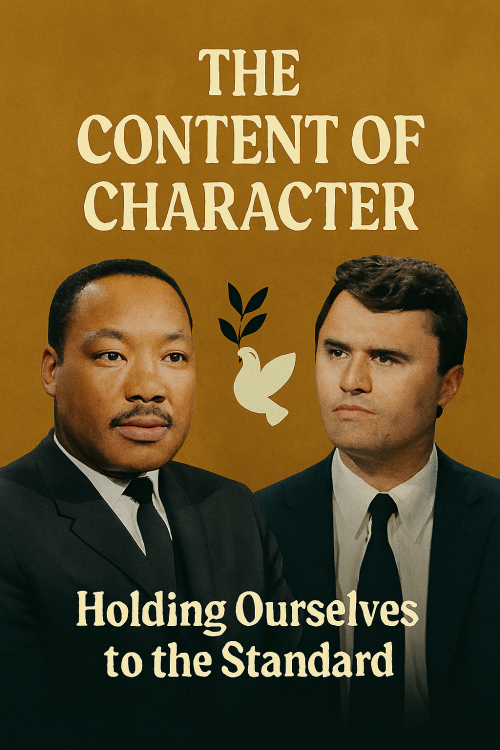
The Content Of Character

“If I see a Black pilot, I’m going to be like, ‘Boy, I hope he’s qualified.’”
—Charlie Kirk, ThoughtCrime
Charlie Kirk’s comment, made during a discussion on Diversity, Equity, and Inclusion (DEI), was intended as a critique of race-based hiring. But the reaction it reveals—skepticism triggered by skin color—raises a deeper contradiction.

“I have a dream that my four little children will one day live in a nation
where they will not be judged by the color of their skin but by the content of their character.”
—Dr. Martin Luther King Jr.
Kirk has often echoed this sentiment. He’s publicly advocated for judging people by merit, not identity. In fact, that’s his stated objection to DEI: that it undermines meritocracy.
But here’s the irony.
To assume a Black pilot was placed there by DEI is to judge him by the color of his skin—not the content of his character, nor the rigor of his training, nor the thousands of flight hours he may have logged. It’s a reflex that contradicts the very principle Kirk claims to defend.
What If the Pilot Were a Woman?
Let’s flip the scenario. If the pilot were a woman—regardless of race—would the same doubt arise?
Would Kirk say, “I hope she’s qualified,” or would he assume she earned her wings?
If not, why the difference?
Both race and gender have been historically excluded from elite professions. Both have benefited from DEI initiatives. Yet skepticism seems to land harder on Black professionals. That’s not just a policy debate—it’s a cultural tell.
The Celebration of Death: Another Contradiction
When news of Charlie Kirk’s death spread, some voices in the anti-gun violence community responded with celebration. Memes, mockery, and “good riddance” posts flooded timelines.
But here too, we find a contradiction.
If we claim to value life—if we grieve every senseless death, if we march for peace and plead for compassion—then how do we justify rejoicing when someone we disagree with dies?
Isn’t that the same dehumanization we protest?
Isn’t that the same moral shortcut we accuse others of taking?
If we believe in restorative justice, in empathy, in the possibility of change—then we must extend that ethic even to those who challenge us. Otherwise, we risk becoming what we oppose.
The Spirit of Divide: When Both Sides Lose the Plot
We are living in a time when political identity has become a substitute for moral clarity.
The right accuses the left of destroying tradition, undermining merit, and weaponizing identity.
The left accuses the right of clinging to power, denying justice, and masking prejudice as principle.
And both sides—when pushed to extremes—begin to mirror the very behaviors they claim to oppose.
• The right says it values faith, family, and freedom—yet often defends cruelty, exclusion, and contempt for the vulnerable.
• The left says it values compassion, equity, and truth—yet often justifies mockery, censorship, and moral superiority.
We’ve all compromised something.
We’ve all made peace with tactics that betray our stated values.
We’ve all cheered when “our side” wins—even if it means someone else is dehumanized in the process.
And we’ve all, at times, confused conviction with tribalism.
Dr. King’s Principles of Nonviolence
Dr. King’s philosophy of nonviolence wasn’t just about avoiding physical harm—it was about cultivating a moral posture that refused to mirror the hatred it opposed.
One of his six core principles states:
“Nonviolence seeks to defeat injustice, not people.”
Another, often overlooked, is this:
“Nonviolence is a way of life for courageous people.”
It resists not only physical violence but also violence of the spirit—including violent speech, ridicule, and humiliation.
This principle is especially relevant now.
When we mock the dead, reduce people to caricatures, or weaponize our words to wound—we violate the ethic of nonviolence, even if our cause is just.
The Teachings of Jesus
Jesus didn’t just condemn physical violence—he confronted the violence of contempt.
“But I say to you that everyone who is angry with his brother will be liable to judgment…
and whoever says, ‘You fool!’ will be liable to hell.”
—Matthew 5:22
This wasn’t hyperbole. It was a warning against the spiritual cost of dehumanizing others.
Jesus taught that the ethic of love must extend even to enemies. That mercy must override mockery. That truth must be spoken in love—or it ceases to be truth.
This Is Not a Demonization
This isn’t about vilifying Charlie Kirk. And it’s not about condemning those who oppose DEI or those who fight for gun reform.
It’s about naming the tension between what we say we believe—and how we instinctively react.
It’s about asking:
Are we truly judging by merit? Are we truly valuing life? Or are we letting our reflexes override our principles?
It’s about recognizing that both sides—when pushed to extremes—can betray the very values they claim to defend.
“I Am Convinced That Men Hate Each Other Because…”
“I am convinced that men hate each other because they fear each other.
They fear each other because they don’t know each other.
They don’t know each other because they don’t communicate with each other.
They don’t communicate with each other because they are separated from each other.”
—Dr. Martin Luther King Jr.
This quote doesn’t just diagnose the problem—it maps the cure.
If fear breeds hatred, and silence breeds fear, then the antidote is proximity. Conversation. Curiosity. Courage.
So how do we change that?
Suggestions for Building the World King, Jesus, and Charlie Envisioned
• Start with curiosity, not certainty.
When someone says something that offends or confuses you—pause. Ask what they meant. Ask what shaped that view. Ask what they fear. You might find a human behind the headline.
• Refuse to flatten people into symbols.
Charlie Kirk is not the embodiment of evil. Nor is every DEI critic a racist. Nor is every activist a saint. People are more than their soundbites. Let’s treat them that way.
• Hold your own side accountable.
If you believe in compassion, apply it to your enemies. If you believe in merit, apply it to your assumptions. If you believe in justice, apply it to your own reflexes.
• Resist violence of speech.
Ridicule, contempt, and mockery are not harmless. They erode the ethic we claim to uphold. Let’s speak truth—but with grace.
• Create spaces for shared vulnerability.
Not just debate. Not just policy. But storytelling. Lament. Testimony. The kind of dialogue where people risk being changed.
• Build coalitions around values, not tribes.
You don’t have to agree on everything to agree on something. Safety. Fairness. Dignity. Let that be the starting point.
The Invitation
This isn’t a call to compromise your convictions. It’s a call to embody them.
To live the ethic you preach.
To judge by character—and mean it.
To value life—even when it challenges you.
To speak truth—but without violence.
To resist tribalism—even when it feels righteous.
Because the dream isn’t just about policy.
It’s about proximity.
It’s about knowing each other.
And it starts with us.