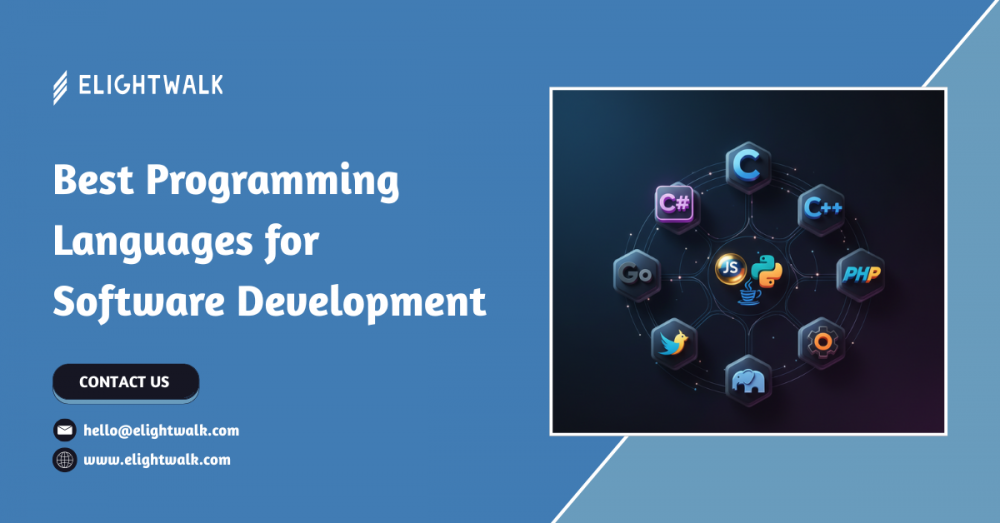
The world of software development is huge, fluid, and ever-evolving. At the heart of every software solution that we deliver is its programming language. Whether it is building big enterprise applications, cutting-edge mobile apps, or scalable web solutions, developers rely on programming languages as basic tools. With so many options available, choosing the best programming language for software development often depends on project requirements, industry trends, community support, and the specific problem being solved.
This blog highlights the most popular and effective programming languages that continue to dominate the software industry, helping businesses and developers make informed choices.

JavaScript
Still known as hardcore web development, JavaScript powers both frontends for the client and server of modern applications. It is an essential engineering language used in building interactive user interfaces, dynamic web pages, and responsive applications. Thanks mainly to React, Angular, Vue.js, and Node.js, JavaScript has gone beyond its age-old role and emerged as an all-purpose tool for developers.
- Best for: Web applications, full-stack development, cross-platform apps.
- Strengths: Huge ecosystem, versatile frameworks, asynchronous capabilities, strong developer community.
- Notable Use Cases: Facebook, LinkedIn, and Netflix use JavaScript-based frameworks for a great user experience.
Python
Python has established itself as one of the most versatile software engineering languages. Its clean syntax and readability make it suitable for rapid development, while its extensive libraries empower developers to build applications across multiple domains such as data science, artificial intelligence (AI), machine learning, and web development.
- Best for: AI, machine learning, web development, automation, and scientific computing.
- Strengths: Easy to learn, strong libraries (TensorFlow, NumPy, Django), cross-disciplinary usability.
- Notable Use Cases: Instagram, YouTube, and Spotify use Python to efficiently run very complex backend systems.
Java
Java has long been a well-liked programming language for software engineering, dominating the world of enterprise-level applications, financial applications, and mobile applications for Android. It has platform independence through the use of the Java Virtual Machine (JVM), and is therefore one of the most trusted programming languages by businesses seeking to grow.
- Best for: Large-scale systems, Android development, enterprise applications.
- Strengths: Secure, stable, platform-independent, object-oriented.
- Notable Use Cases: Businesses like Twitter, Amazon, and eBay use Java for their core backend systems.
C#
Developed by Microsoft, C# is a powerful engineering language widely used within the .NET framework. It is commonly employed for desktop applications, enterprise solutions, and especially for game development with Unity, one of the most popular game engines in the world.
- Best for: Game development, desktop solutions, enterprise-level software.
- Strengths: Strong support in the Microsoft ecosystem, integration with Azure, and efficient memory management.
- Notable Use Cases: Unity-powered games and several enterprise applications rely heavily on C# as the core language.
C and C++
C is frequently regarded as the basis for contemporary programming. While C has had a history of several decades now, it remains a critical programming language for systems programming, embedded devices, and applications where performance is critical. Its successor, C++, extends its capabilities with object-oriented features, making it suitable for game engines, simulation applications, and operating systems.
- Best for: System-level programming, game engines, embedded systems.
- Strengths: High performance, low-level access to memory, portability.
- Notable Use Cases: Operating systems like Windows, Linux, and macOS still rely on C and C++.
PHP
PHP, a veteran among software engineer languages, is still widely used due to its simplicity and dominance in server-side scripting. Although newer languages are rising in popularity, PHP powers almost 77% of websites, including major platforms like WordPress.
- Best for: Server-side web development, CMS platforms.
- Strengths: Easy integration with databases, cost-effective, large open-source community.
- Notable Use Cases: WordPress, Wikipedia, and Slack have roots in PHP.
Swift
Swift is the preferred engineering language for developing iOS and macOS applications. Introduced by Apple, it is modern, fast, and designed to be safer than its predecessor, Objective-C. Its popularity is evident as businesses increasingly target Apple users.
- Best for: iOS, macOS, watchOS, and tvOS application development.
- Strengths: Fast, optimized for performance, and syntactically friendly for developers.
- Notable Use Cases: Apps like Airbnb and Lyft rely on Swift for smooth iOS experiences.
Go (Golang)
Go, developed by Google, has gained traction for building cloud-native applications and scalable backend systems. It is simple, efficient, and built for concurrency, making it one of the fastest-growing software engineer languages.
- Best for: Cloud computing, microservices, web servers.
- Strengths: Fast compilation, concurrency support, growing adoption in cloud ecosystems.
- Notable Use Cases: Popular platforms like Docker and Kubernetes are written in Go.
Kotlin
Kotlin has transitioned to being the official language used for Android development, helping to improve productivity while alleviating boilerplate code and a lot of the verbose syntax used in Java. Kotlin is adopted by an array of large tech organizations, and teams are typically able to easily migrate to Kotlin from Java because of Kotlin's interoperability with Java.
- Best for: Android applications, server-side applications.
- Strengths: Modern features, concise syntax, official support from Google.
- Notable Use Cases: Pinterest and Trello use Kotlin for their Android apps.
Rust
Rust has become one of the most exciting engineering languages, focusing on safety, concurrency, and performance. Its ability to guarantee memory safety without garbage collection allows developers to be confident when building secure applications.
- Best for: System programming, web assembly, blockchain solutions.
- Strengths: Safe memory handling, efficient concurrency, rapid adoption.
- Notable Use Cases: Dropbox and Firefox use Rust in their critical systems.
Conclusion
Each programming language has its own unique features to offer. While JavaScript and Python are generally regarded as the kings of web applications and AI-generated applications, Java and C# still dominate enterprise-level projects. For mobile-first businesses, Swift and Kotlin are popular choices that provide ease of development, while Rust and Go are quickly emerging as leaders in building secure, scalable systems.
Ultimately, the best engineering language comes down to intended use, project requirements, and the expertise of the team working on the project. Companies need to ensure that their choice of software engineering languages is in line with long-term goals if they want to deliver scalable, efficient, and future-ready application solutions.
For those ready to start building innovative applications, it is often a smart decision to hire software developers with proven expertise. Especially for businesses seeking cost-efficient yet skilled talent, it is beneficial to hire software developer India teams capable of delivering high-quality solutions at scale.