
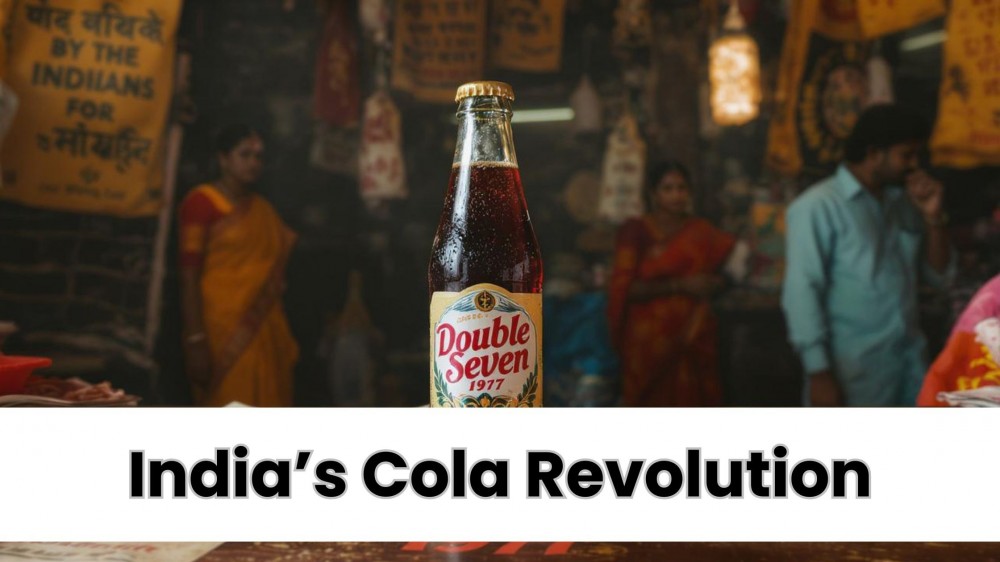
In 1977, India’s beverage industry witnessed a bold experiment with the launch of Double Seven, a government-backed cola brand. This initiative was a significant milestone in India’s Cola Revolution, aiming to reduce dependence on foreign companies while promoting indigenous products. Following the Janata Party’s rise to power under Morarji Desai, Coca-Cola was expelled from the Indian market after refusing to comply with the Foreign Exchange Regulation Act (FERA), which required sharing its secret formula. Double Seven emerged as a patriotic alternative, symbolizing self-reliance, economic independence, and national pride.
Government Initiative and Launch Strategy
Double Seven was produced by Modern Food Industries, a government-owned enterprise, and launched at the Pragati Maidan trade fair in New Delhi. The brand’s name, “Double Seven,” was chosen through a nationwide competition, reflecting the year 1977 and the public’s enthusiasm for change. The cola formula was developed at the Central Food Technological Research Institute in Mysore to meet local taste preferences, ensuring that it resonated with Indian consumers.
The government prioritized nationwide distribution, ensuring the product reached urban centers and smaller towns alike. This strategy was both practical and symbolic, showcasing India’s capability to produce a cola that could rival international brands.

Marketing Strategy: Patriotism Meets Consumer Appeal
Double Seven’s marketing campaign was groundbreaking for its time, combining consumer appeal with patriotic messaging. Advertisements highlighted themes of self-reliance and national pride, portraying Double Seven as more than just a beverage. Slogans such as “For the good times” and “India’s own cola” resonated strongly with the public.
Celebrity endorsements were a crucial part of the campaign. Popular actors and public figures appeared in advertisements, linking the cola to India’s cultural identity and post-Emergency resurgence. This approach positioned Double Seven as a symbol of the nation’s industrial and economic aspirations.
Competition from Domestic Brands
Despite government support, Double Seven faced competition from domestic brands like Thums Up and Campa Cola. Thums Up, known for its bold taste and aggressive marketing, had already secured a loyal consumer base. Campa Cola also maintained a strong presence in certain regions.
Double Seven’s initial challenges stemmed from taste preferences and brand loyalty. While patriotic messaging helped, the cola’s flavor profile did not appeal to all consumers. Nonetheless, the brand’s government backing and symbolic value allowed it to hold a significant market share for several years.
Consumer Reception and Cultural Impact
Double Seven quickly became a cultural phenomenon. Purchasing the cola was seen as a patriotic act, with families, schools, and offices choosing it over foreign alternatives. Local vendors promoted it as India’s own cola, further embedding it in public consciousness.

The brand also influenced media and pop culture. Newspapers, radio shows, and television programs featured Double Seven as a symbol of India’s industrial capabilities and self-reliance. For many consumers, drinking the cola was not just a beverage choice—it was a statement of national pride.
Operational Challenges
Despite its popularity, Double Seven faced several operational issues. Production infrastructure sometimes struggled to meet demand, particularly in smaller towns. Regional taste preferences also varied, and many consumers continued to prefer Thums Up or Campa Cola.
The brand’s limited experience in marketing, packaging, and distribution compared to international players also hindered its urban market performance. These operational challenges contributed to the brand’s inability to dominate the market long-term.
Decline Amid Political Shifts
Double Seven’s decline began in the early 1980s with the return of Indira Gandhi’s government. The administration was less interested in supporting a brand associated with the previous government, leading to decreased promotion and eventual phase-out.
Meanwhile, domestic competitors like Thums Up strengthened their market presence, and Coca-Cola remained absent until India’s economic liberalization in 1993. The lack of political support and evolving consumer preferences contributed to Double Seven’s decline.
Coca-Cola’s Return and Market Transformation
Coca-Cola’s return in 1993, alongside PepsiCo, transformed India’s beverage industry. Large marketing budgets, modern distribution networks, and global strategies reshaped consumer behavior. Although Double Seven had vanished, domestic brands like Thums Up survived and even thrived, maintaining consumer loyalty.
The Cola Revolution demonstrated that government-backed initiatives could create impactful brands, even if their lifespan was temporary. Double Seven’s story inspired other domestic brands and highlighted the importance of national pride in marketing and consumer choice.
Legacy of Double Seven and India’s Cola Revolution
Double Seven is remembered not only as a cola but as a symbol of India’s attempt to assert economic independence. While the brand no longer exists, its cultural and historical significance remains. It influenced consumer perceptions, inspired the rise of other domestic brands, and demonstrated India’s ability to compete with multinational corporations.
The Cola Revolution left a lasting legacy, emphasizing the intersection of politics, culture, and commerce. Double Seven remains a case study in patriotic branding, government-backed industry, and the evolution of India’s soft drink market.
Read Full Article : https://bizinfopro.com/news/marketing-news/indias-cola-revolution-how-double-seven-replaced-coca-cola/
About Us : BizInfoPro is a modern business publication designed to inform, inspire, and empower decision-makers, entrepreneurs, and forward-thinking professionals. With a focus on practical insights and in‑depth analysis, it explores the evolving landscape of global business—covering emerging markets, industry innovations, strategic growth opportunities, and actionable content that supports smarter decision‑making.





