

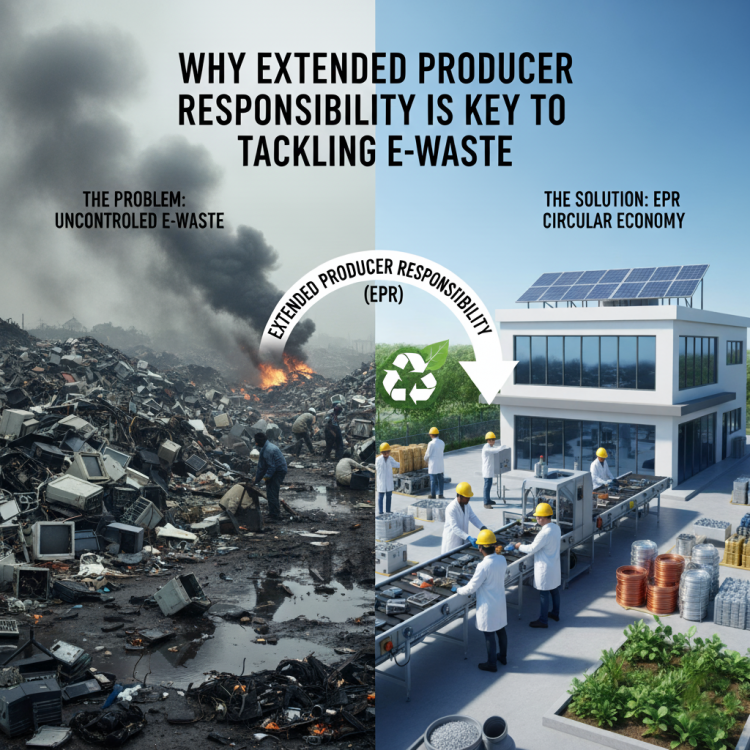
Electronics is what the world is running on - the phone that wakes us up to the laptop on which we spend our day is powered by technology. But every shiny new gadget has a darker side — what happens when they are no longer useful? The old equipment does not disappear; instead, it accumulates, and that accumulation of e-waste is becoming an international menace.
The amount of electronic waste that is discarded in the world annually is in millions of tonnes, most of which is deposited in landfills or informal recycling stations, where they are damaging the environment and the health of the human species. Hence, responsible management of such waste has become one of the top-priority sustainability issues of the present. And that is precisely where Extended Producer Responsibility (EPR), also known as EPR e waste management, comes into play as a game changer.
What exactly is EPR e Waste?
Fundamentally, EPR e-waste is concerned with accountability. It puts pressure on producers (manufacturers, importers, and brand owners) to be responsible for their products throughout their entire life cycle. In simpler terms, when a company sells an electronic product, it will also need to provide a way of collecting, recycling, or disposing of the product after it has been used by consumers.

EPR removes the load of waste management on the consumers and the local authorities and imposes it on the same persons, the producers, who can and should make significant decisions. This not only pushes the companies to create products that can last longer and can be recycled, but also gives rise to a system in which waste is seen as a resource and not a problem.
The Importance Of EPR on Addressing E-Waste
E-waste is much more complicated than normal trash. Every machine has a combination of metals, plastics, and dangerous chemicals. These parts are dumped randomly, releasing toxins into soil and water, posing a threat to the ecosystem and human health.
Through adopting the EPR e-waste frameworks, nations may develop an organized framework for gathering, sorting, and safe recycling of disposed electronics. Thus, valuable materials such as copper, gold, and aluminum can be collected and recycled instead of being left in informal dumps.
This will lessen the dependence on raw mining, which is resource-consuming and harmful to the environment, and consequently will promote a circular economy in which resources are used in the production process again.
In addition, EPR promotes innovativeness amongst companies. With the assurance of having to take care of the end-of-life of their products, they will be more willing to invest in eco-designing, i.e., making products that can be modular, repairable, and recyclable. EPR is therefore not just waste disposal but also a change of mind about the way we process manufacturing and consumption.

The Indian Perspective
India is one of the leading producers of e-waste in the world, with a strong annual production of more than 1.6 million tonnes. However, a very low percentage of such waste is collected and reused by the approved methods. The industry is still dominated by informal recyclers who tend to operate unprotected and employ unhealthy techniques such as open burning and acid baths.
In response to this, the Indian government came up with E-Waste (Management) Rules that entrench EPR e-waste obligations in the laws. The producers must now be registered with the Central Pollution Control Board (CPCB) and provide EPR plans, and also attain annual collection targets. Thus, waste management can no longer be a sideline issue in companies, but a mandatory compliance and an ethical obligation.
Although the implementation is still in its infancy, this system is slowly creating a more structured, responsible recycling system in the country. Collection drives, licensed recyclers, and awareness campaigns are helping to close the gap between the consumer and the responsible disposal methods.
Challenges on the Road Ahead
Naturally, there are no issues related to EPR e-waste implementation. Most manufacturers find it hard to track products after they are sold, particularly when it comes to a market as large and unstructured as India. Even consumers are usually unknowledgeable about how or where to dispose of old electronics responsibly.
Therefore, education is important! The general awareness, school activities, and corporate efforts may educate the population on the importance of disposing of old devices in the right way. Conversely, tighter controls and computer monitoring can make sure that producers remain liable to their EPR commitments.
The other major problem is cooperation. It cannot be the work of one group to deal with e-waste. Governments, businesses, recyclers, and citizens need to collaborate in order to establish a system that really works. Hence, it is a collective feeling of responsibility, rather than regulatory control, that will enable EPR to work in the long term.
The Bigger Picture: A Step towards a Circular Future
EPR e-waste structures can be revolutionary when properly implemented. They can transform the mess of the unprocessed waste into a well-organized system of sustainable resources whereby resources are reused, pollution is kept to a minimum, and livelihoods are generated. The process creates green employment in collection and recycling, decreases the strain on landfills, and decreases carbon emissions through a decrease in the use of virgin materials.
Essentially, EPR is not merely a policy, but it is a change of mindset. It transforms the concept of being a producer in the 21st century and challenges companies to own their impact, both throughout the value chain.
Thus, the second time you recycle an old phone or purchase a new appliance, you should keep in mind that it does not stop its life in the garbage bin. The EPR e-waste systems have been installed in the country, and with them, that gadget that was thrown away will have a different use- it will be used in a new form as a recycled product rather than being toxic waste.





