

In modern manufacturing and product development, quality control is not just a requirement—it’s a promise of reliability, durability, and customer trust. Among the many tools that ensure consistent product performance, the tensile strength tester, also known as a tensile testing machine, stands out as one of the most essential instruments in material testing.
From packaging films to metal wires, plastics, and textiles—understanding how materials behave under tension is key to ensuring they meet performance expectations. A tensile strength tester helps manufacturers determine how strong, flexible, and resilient their materials are before they reach the end-user.
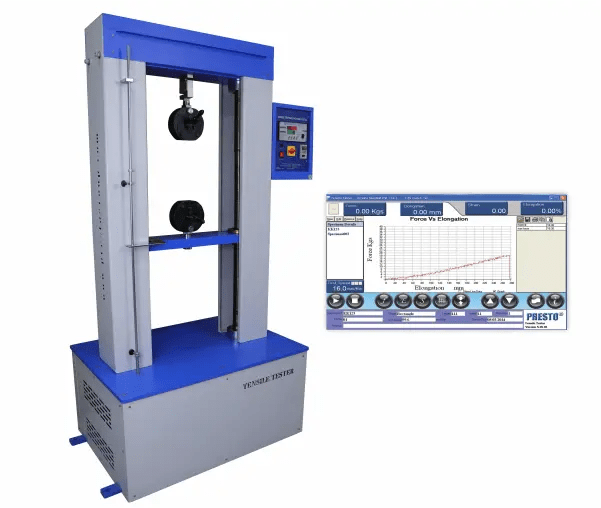
Let’s explore what a tensile strength tester is, how it works, its importance across industries, and why investing in a reliable testing solution such as the Tensile Tester Computerised Cum Digital by Presto Instruments can elevate your quality control standards.

What Is a Tensile Strength Tester?
A tensile strength tester is a specialized machine designed to apply controlled tension (pulling force) to a specimen until it breaks. The test measures how much force the material can withstand, as well as how it deforms before reaching its breaking point.
The main purpose of tensile testing is to determine a material’s tensile strength, elongation, yield strength, and modulus of elasticity. These properties help in understanding the mechanical performance and durability of materials under various conditions.
How Does a Tensile Testing Machine Work?
The working principle of a tensile testing machine is simple yet precise. The material specimen is clamped between two jaws—one fixed and one movable. The movable jaw applies a pulling force gradually, and the machine continuously records the applied load and the resulting elongation until the material breaks.
The data collected during this process is plotted on a stress-strain curve, which gives engineers valuable insights into the mechanical properties of the tested sample.
A typical tensile testing process includes:

- Sample Preparation: Cutting the specimen to a standard shape and size.
- Mounting: Clamping it between the grips of the machine.
- Testing: Gradually applying tension to stretch the sample.
- Data Recording: Measuring the load, elongation, and breaking point.
- Analysis: Calculating key material properties like tensile strength and elongation percentage.
Why Is Tensile Testing Important?
Tensile testing is a fundamental method for understanding material behavior and ensuring consistent product quality. It helps manufacturers and researchers make data-driven decisions regarding design, production, and material selection.
Here’s why tensile testing is crucial in any industry:
- Assures Quality and Consistency
Regular tensile testing ensures that materials meet required quality standards and behave consistently across batches. - Enhances Product Safety
Knowing the breaking strength of materials prevents failures in critical applications such as packaging, construction, or automotive parts. - Supports Product Development
Engineers rely on tensile test data to develop new materials or improve existing ones for better strength and flexibility. - Ensures Regulatory Compliance
Many industries require tensile testing to meet international standards such as ASTM, ISO, or BIS guidelines. - Reduces Production Costs
Identifying weak materials early helps avoid costly reworks and product recalls.
Key Features of a Modern Tensile Strength Tester
With advancements in testing technology, today’s tensile testers are far more sophisticated than traditional manual models. The Tensile Tester Computerised Cum Digital by Presto Instruments is a prime example of innovation meeting precision.
Here are some standout features that make it a preferred choice:
- High-Precision Load Cells: Ensure accurate measurement of tensile force during testing.
- Digital + Computerized Operation: Combines the accuracy of digital readouts with the convenience of computer-based data recording and analysis.
- Rigid Frame Construction: Guarantees stability and prevents vibration during testing.
- User-Friendly Interface: Simple controls for easy operation and report generation.
- Customizable Grips and Fixtures: Accommodates various materials, from films and rubber to metals and wires.
- Real-Time Data Display: View stress-strain curves, elongation graphs, and breaking force instantly.
Applications of Tensile Testing Machines
Tensile strength testers are used across a wide range of industries, each with unique material testing needs.
- Packaging Industry:
Used to test the tensile strength and elongation of packaging materials like BOPP films, laminates, and plastic pouches. Ensures the packaging can handle mechanical stress during transportation and storage. - Plastics and Polymers:
Helps manufacturers evaluate polymer strength, flexibility, and elongation before production. Ensures that the plastic products meet durability standards. - Textile Industry:
Measures the breaking strength and elasticity of yarns, fabrics, and woven materials to ensure comfort and reliability in final products. - Metal and Engineering Materials:
Determines the yield strength, ductility, and breaking load of metal samples used in construction, automotive, and aerospace industries. - Rubber and Elastomers:
Evaluates stretchability and elasticity to ensure performance under pressure and repeated use.
Why Choose Presto Instruments?
Presto Instruments is one of India’s most trusted names in testing equipment manufacturing. With decades of experience and a commitment to innovation, Presto provides reliable, durable, and precision-engineered instruments that help businesses maintain world-class quality standards.
Their Tensile Tester Computerised Cum Digital model offers advanced testing capabilities while remaining user-friendly and cost-effective. It is built to deliver accurate, repeatable, and compliant results across a wide range of materials.
Key Benefits of Choosing Presto’s Tensile Strength Tester:
- Fully compliant with international testing standards.
- Sturdy and long-lasting design for industrial use.
- High accuracy in measurement and data reporting.
- Excellent after-sales support and calibration services.
Conclusion
The tensile strength tester is not just a lab instrument—it’s a powerful tool that defines the quality, safety, and performance of your materials and products. Whether you are testing packaging films, textiles, metals, or polymers, a reliable and accurate testing system ensures that your materials meet both internal and international quality benchmarks.
Investing in a high-quality tensile testing machine, such as the Tensile Tester Computerised Cum Digital from Presto Instruments, ensures precision, reliability, and long-term performance for all your testing needs.
Bring accuracy, confidence, and excellence to your quality control process—choose Presto for your next tensile testing solution.





