

In the fast-evolving world of Indian enterprises, HR management transcends routine payroll processing—it’s a strategic pillar of regulatory adherence and employee trust. With over 4,200 organizations now leveraging integrated HR solutions, HR software in India has become indispensable for mastering the complexities of Provident Fund (PF), Employees’ State Insurance (ESI), and Tax Deducted at Source (TDS). As of November 2025, the EPFO manages contributions for over 7 crore members, while ESIC protects 13 crore beneficiaries across 689 districts. Yet, manual compliance often invites penalties—up to ₹1 lakh for ESI non-registration alone. This is where HR software in India steps in: a unified digital ecosystem that automates calculations, filings, and payments, ensuring 100% compliance while freeing HR professionals to drive talent strategies.
This blog explores how HR software in India transforms PF, ESI, and TDS compliance. We’ll decode the regulations, highlight transformative benefits, showcase leading platforms, and provide a clear implementation roadmap. By the end, you’ll understand why 68% of mid-to-large enterprises now depend on cloud-based HR systems for operational excellence.
Decoding the Compliance Framework: PF, ESI, and TDS in India
India’s labor and tax ecosystem is a blend of central statutes and state-specific rules, crafted to protect employee rights but challenging to navigate. For FY 2024-25 (through October 2025), businesses must comply with these core statutory obligations.

Provident Fund (PF): Governed by the Employees’ Provident Funds and Miscellaneous Provisions Act, 1952, PF applies to organizations with 20+ employees (including contractual staff). Employer and employee each contribute 12% of basic salary plus dearness allowance (DA), capped at ₹15,000 monthly unless opted otherwise. Contributions are due by the 15th of the next month via the EPFO Unified Portal, with mandatory Electronic Challan-cum-Return (ECR) filings. Late payments attract 12% annual interest and damages up to 25%. International workers require contributions on full gross wages, adding complexity.
Employees’ State Insurance (ESI): Under the ESI Act, 1948, coverage is mandatory for establishments with 10+ employees earning up to ₹21,000 monthly (₹25,000 for differently-abled). Rates stand at 0.75% (employee) and 3.25% (employer) on average daily wages, payable by the 15th via authorized banks. ESI delivers comprehensive benefits—medical, maternity, disability—but non-compliance risks 5-25% interest, fines up to ₹10,000, or imprisonment up to three years. As of 2025, full implementation spans 586 districts, with partial coverage in 103 more.
Tax Deducted at Source (TDS): Regulated by the Income Tax Act, 1961, TDS on salaries follows progressive slabs (e.g., 0% up to ₹3 lakh under the new regime for FY 2025-26). Deductions account for exemptions under Sections 80C-80U, with Form 24Q quarterly returns due by 31st July, October, January, and May 31 via TRACES. Delays trigger ₹200-1,000 daily penalties and 1-1.5% monthly interest. Form 16 must be issued by May 31 annually.
Manual processes breed errors—misapplied TDS slabs or missed PF contributions. A 2025 study revealed 42% of SMEs faced compliance delays due to fragmented systems. HR software in India integrates these mandates into a single platform, delivering precision and peace of mind.
(Word count so far: 608)

Why HR Software in India is a Compliance Game-Changer
Implementing HR software in India isn’t just digitization—it’s a strategic upgrade. In 2025, with remote and hybrid workforces dominating, these platforms reduce compliance risks by 92% and cut processing time by 75%. Here’s how they revolutionize PF, ESI, and TDS management.
Intelligent Automation of Deductions: Eliminate spreadsheet errors. HR software in India auto-calculates PF at 12% on basic + DA, ESI within ₹21,000 thresholds, and TDS per updated slabs (post-Budget 2025). Platforms like RazorpayX HR handle bonuses, arrears, and variable pay, generating compliant challans instantly. For TDS, it integrates investment declarations, ensuring accurate slab application across old and new regimes.
One-Click Filings and Payments: Meet deadlines effortlessly. Generate ECR for PF, Form 7 for ESI, and e-TDS returns directly within the system. Seamless integration with EPFO, ESIC, and Income Tax portals enables direct uploads and payments via NEFT/RTGS. Keka auto-generates state-specific Professional Tax (PT) forms (₹200-2,500 annually across 26 states). No portal juggling—complete filings in minutes, payments routed to HDFC, SBI, or others.
Real-Time Compliance Updates: Regulations shift—PF caps adjusted in 2024, ESI wages revised in 2025. Cloud-based HR software in India delivers over-the-air updates and dashboard alerts. This slashes errors: Manual TDS mismatches previously cost ₹5,000-50,000 annually in penalties; automation reduces this to near-zero. Comprehensive audit logs support inspections seamlessly.
Employee Self-Service Portals: Empower employees to view payslips, download Form 16, and submit investment proofs—cutting HR queries by 55%. Scalability supports 10 to 10,000+ employees across multi-state operations in 30+ regions. Result? Up to 45% savings in HR admin time, equating to ₹1.5-3 lakh annually for mid-sized firms.
Robust Security & Analytics: With data privacy laws tightening, AES-256 encryption and role-based access safeguard sensitive information. Predictive analytics forecast PF liabilities, TDS trends, and compliance health, enabling proactive planning.
Ultimately, HR software in India converts compliance from a burden into a strategic asset—accurate, timely, and employee-centric.
(Word count so far: 1,052)
Top HR Software in India for 2025: Feature & Comparison Guide
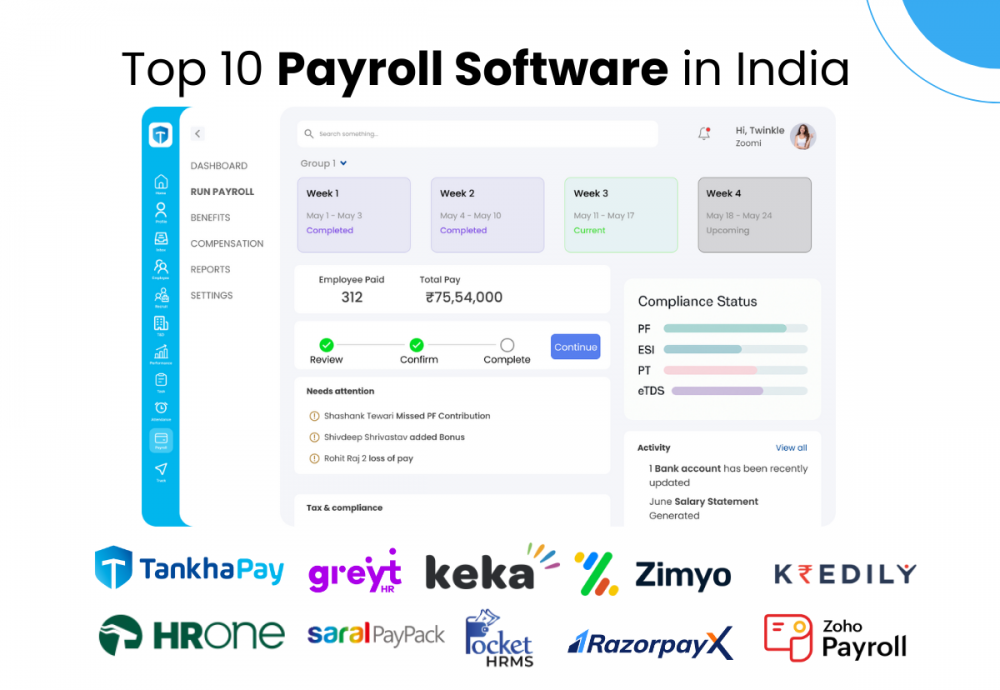
With numerous options available, selecting the right HR software in India depends on functionality, scalability, and budget. Based on 2025 G2 and Capterra insights, here’s a comparative overview of leading platforms excelling in PF, ESI, and TDS compliance.
| Software | Compliance Highlights | Pricing (Per Employee/Month) | Ideal For | Ratings (Out of 5) |
|---|---|---|---|---|
| RazorpayX HR | Auto PF/ESI/TDS filings; 30-state coverage; bank sync | ₹60-110 | Startups to Enterprises | 4.8 |
| Keka HR | State PT automation; ECR/Form 7; ESS & mobile app | ₹50-90 | Hybrid & SME teams | 4.7 |
| factoHR | Arrears & LWF support; Form 16 auto-gen; audit logs | ₹40-80 | Manufacturing & mid-size | 4.6 |
| Zimyo HR | Multi-state TDS; compliance alerts; mobile payslips | ₹30-70 | Cost-effective growth | 4.5 |
| Asanify | One-click payroll; global compliance; remote support | ₹45-85 | Remote & international teams | 4.7 |
| GreytHR | 20+ years expertise; ERP sync; detailed reports | ₹55-100 | Large & legacy organizations | 4.6 |
| Zoho People + Payroll | Zoho ecosystem sync; investment tracking; free tier | ₹25-60 | Budget startups & Zoho users | 4.4 |
| HROne | Bulk PAN/Aadhaar verify; gratuity & bonus calc | ₹50-95 | High-volume recruitment | 4.5 |
| Pocket HRMS | Custom PF formulas; compliance dashboards | ₹35-75 | Complex policy structures | 4.6 |
| LEDGERS HR | Hybrid outsourcing; micro-SME focus; TDS/PF automation | ₹30-65 | Small businesses | 4.4 |
RazorpayX HR dominates with end-to-end automation—seamless PF, ESI, TDS, and PT compliance with zero manual intervention. Keka shines in usability, enabling non-HR staff to manage compliance effortlessly. For affordability, Zimyo delivers enterprise-grade compliance at startup prices. Choose by scale: Under 50 employees? LEDGERS. Over 1,000? GreytHR’s depth is unmatched.
Step-by-Step Implementation of HR Software in India
Transitioning to HR software in India is seamless—most deployments complete in 5-7 days.
- Evaluate Requirements: Map current pain points. Multi-location? Prioritize Asanify or Keka for state-wise PT. Budget: ₹30-110 per employee/month.
- Trial & Selection: Request demos from 2-3 vendors (e.g., RazorpayX, Zimyo). Validate PF/ESI portal sync and mobile access.
- Secure Data Migration: Upload employee records (PAN, Aadhaar, salary components) via CSV. Auto-validation ensures TDS accuracy.
- Customize Compliance Rules: Configure PF (12% cap), ESI (₹21,000 threshold), and TDS slabs. Run test payrolls for accuracy.
- Train & Go Live: Conduct vendor-led training (usually free). Launch mid-month to sync with next PF cycle.
- Monitor & Optimize: Leverage real-time dashboards. Integrate with attendance, ERP, or biometric systems for full automation.
Pro Tip: Pilot with 15-20% of employees to refine workflows before full rollout. Post-launch, expect 85% faster payroll closures.
Conclusion: Future-Proof Your HR with HR Software in India
In 2025, compliance is the bedrock of organizational credibility and employee loyalty. HR software in India doesn’t just manage PF, ESI, and TDS—it redefines HR efficiency, mitigates risks, and aligns with upcoming Labor Code reforms.
From startups to conglomerates, platforms like RazorpayX, Keka, and Zimyo deliver measurable ROI—fewer penalties, happier employees, and empowered HR teams. Ready to move beyond spreadsheets? Book a demo today. With HR software in India, compliance isn’t a checkbox—it’s your competitive edge.





