
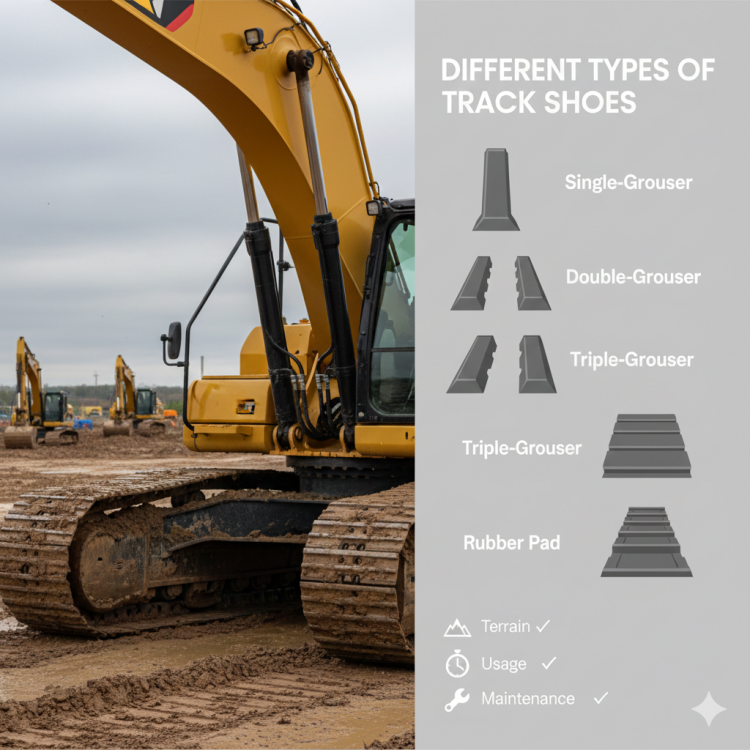
When you consider a Caterpillar dozer or an excavator, the most important, and least thought of part is the track shoe. These rubber or steel pads under the machine dictate the level of gripping the ground, the longevity of the machine undercarriage, and finally, the efficiency and safety of the machine operation. Not every track shoe is identical. Based on your terrain, workload, and which type of machine you have, a proper track shoe selection can save you thousands in repair, and performance would be a lot more dramatic.
This is an easy-to-understand description of the most significant categories of Caterpillar track shoes, what they are useful for, and how to choose the right one to fit your purposes.
- Single-Grouser Shoes - Top Traction
Single grouser track shoes contain a single raised center running bar (or grouser). The design gives good penetration and extremely high traction, particularly in hard, rocky soil or loose soil. This reduces the amount of contact with the flat surfaces, and thus, a single grouser excavates instead of sliding. This is why it can be used on machines that are heavy, such as bulldozers, which have to push or rip steep slopes.
But the deep grouser has the disadvantage of increased wear and may become more difficult to use. In the jobs where traction is more of a priority than maneuverability, it is usually the choice.
- Balanced Grip and Control Double-Grouser Shoes
The shoes with two parallel bars are called double-grousers. This provides the machine with increased grip as compared to rubber or flat shoes, yet increased stability compared to single-grouser shoes. Due to the contact points, load-bearing is enhanced with reasonable maneuverability retention.
Very common on excavators that operate in mixed ground, that is, firm soil, some rock, or uneven ground. You get good traction, but you are not a tank that is difficult to drive.
- Triple-Grouser Shoes - Smooth Turning, Minor Penetration
Triple-grouser shoes are constructed with maneuverability and stability, as opposed to deep digging. Three bars would spread out the contact surfaces better, and they would be good on soft or moderately firm ground.
These are frequently used in construction excavators because additional width and less depth are important in this category, compared to violent traction due to the smooth rotation, less disturbance of the ground, and a stable workstation.

- Special-Use Flat, Notched, Self-cleaning Shoes
Other track shoes do not have grousers at all--they have grousers in strange shapes.
- Flat Shoes: They are smooth at the bottom with no sticking out bars. Flat steel shoes are common when machines are in use on concrete or asphalt surfaces (places that have paved surfaces) as they reduce the damage to the surface.
- Notched / Self-clearing Shoes: These are grooved or cut out on the grouser area to minimize the accumulation of mud, rocks, or debris. The more aggressive versions assist the track in shedding the material more easily, and they can be applied in muddy or place-laden locations.
- Extreme-Service / Super-Extreme Shoes: Caterpillar, in its turn, manufactures SES (Super Extreme Service) shoes, which include significantly more steel and hardened construction to withstand high impact, rocky, or particularly harsh terrain.
- Rubber- or Poly-Bonded Shoes
Not every track of Caterpillar is entirely of steel. There are those shoes with rubber pads (or any other polymer bonding) attached to the steel shoe. These lower noise, vibration, and destruction of the surface finishes, such as roads, parking lots, or concrete slabs.
The merit is evident: the operator will have an easier ride and will cause less damage to the paved roads. However, due to a lack of deep grousers, there is some loss of grip in very rugged or soft ground.
- Swamp / Wide-Pad Shoes
When you have to work in really soft soil, such as swamps, marsh, or very loose sand, you must have as much surface area as you can get. Swamps or wide pad shoes are designed with a larger base in order to spread the weight more uniformly, reducing the weight on the ground and avoiding the machine sinking.
Such special shoes are not more popular in general construction but essential in wetlands or soft-footprint purposes.
The Do-not-Buy Guide to the Track Shoe of a Caterpillar Machine
Making a bad decision can be very expensive, not only in terms of replacement costs but also fuel, time, and productivity. Here's how to pick well.
Understand Your Terrain
- Rocky / in equal step - use single-grouser shoes or SES shoes.
- Mixed construction ground - two grouser or three grouser.
- Paved surface - flat or rubber-bonded footwear.
- Muddy or soft ground - swamp / wide-pad shoes.
Assess Your Usage Pattern
- Frequent turns? Triple grouser or notched self-clearing is good.
- Heavy pushing or ripping? Single grouser or extreme-service.
- Job rotation between types of jobs? Perhaps a rubber bond pad or modular shoes.
Machine Application
- Bulldozers require traction shoes of high quality (single or extreme).
- Excavators may want more maneuverable shoes that are flatter.
- Larger or smaller machines or mini-excavators enjoy the advantage of rubber-padded shoes in reduced vibration.
Maintenance vs Replacement
- If your site is abrasive, you’ll wear shoes fast. Conceptualise the re-grouping possibilities.
- High-maintenance environment? Durability SES / extreme shoes can be profitable.
Cost and Downtime
- SES high-performance shoes are pricier, and it has a longer life span in a rugged environment.
- Flat or rubber shoes are less expensive, yet might wear out sooner or not suit all the soils.
Supplier & Quality
- Purchase reputable OEM or aftermarket manufacturers that sell heat-treated and correctly hardened shoes.
- Ensure that your shoes fit your Caterpillar model (pitch, hole pattern, and so on).
Final Thoughts
Track shoes might not be the glamor part of a Caterpillar machine--but they are very important. The right shoe provides you with grip, underscar, fuel economy, and lowers the cost of maintenance.
Take time to identify your shoe type and terrain, and use. When you pay more attention to these details, your machine will do more business.





