

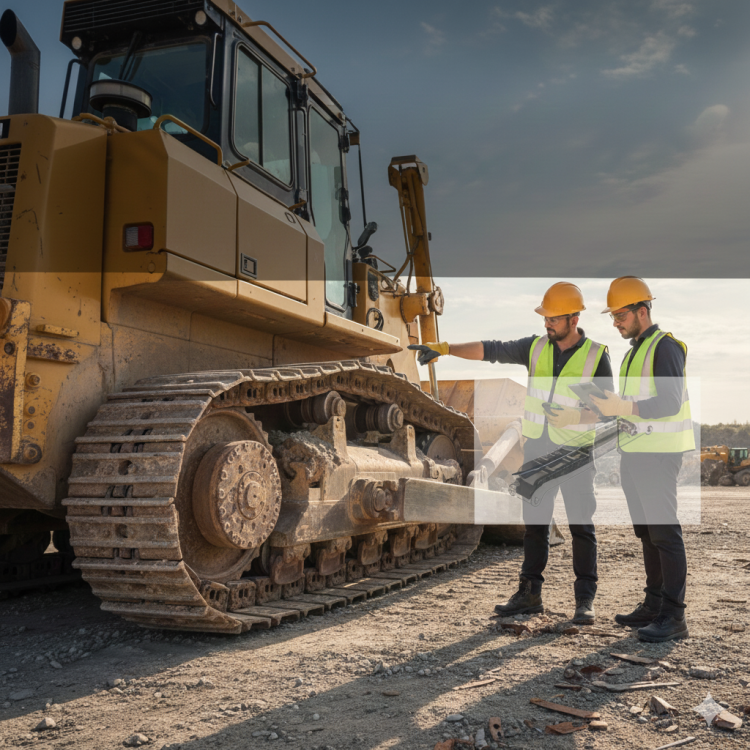
Whether it is an excavator or a dozer, they are an essential part of the construction and mining industry. These machines heavily rely on undercarriages, which bear the maximum load of work. However, they might be designed to carry massive loads over the most unforgiving terrain on earth, yet if not operated smartly, early damages are expected. It is highly important to maintain them and use only high-quality dozer undercarriage parts from a trusted OEM.
Fleet managers know that it is one of the most expensive systems to maintain. According to industry estimates, more than 50% total lifetime maintenance costs of a single dozer are taken up by undercarriage repair. To prevent repair costs from skyrocketing, the operator needs to be careful when handling your undercarriage. Especially, avoid small but troublesome operational habits and overlooked maintenance routines.
In this article, let us help you identify such issues in your day-to-day operation and how to deal with them swiftly.
What Lowers the Lifespan of Dozer Undercarriage Parts?
A healthy undercarriage is identified if its constituent parts are in good shape, as they are the first victim of wear. In particular, within the track chain (considered the backbone of undercarriages), the interface between the pins and bushings serves as the most critical point of wear. This happens when the internal pins rotate against the bushing during active operations. Due to these repeated rotations, the friction starts to wear away the metal on one side of the pin and the matching inner surface of the bushing.

Moreover, the wear gets to a point where it creates a large gap that increases the distance between the pin centres, commonly known as "track stretch." Once this gap is formed, the bushing can no longer line up perfectly with the sprocket teeth. This leads to the bushings riding up on the tooth tip instead of rolling smoothly into the tooth root. Ultimately, the grind from this phenomenon gets so bad that it destroys both the bushing and the sprocket.
To avoid this from happening, avoid overusing the reverse operation. It is responsible for putting the bushing in the scrubbing position against the sprocket. These prompts accelerate wear at nearly double the rate of forward travel. Thus, it is advised to minimise reverse distance as it is best suited for positioning and not for cross-site travel. On the other hand, try to loosen the track a little, as tracks that are too tight run into the issue of a drastic increase in pressure between the pins and the bushings.
Sprockets are Another Dozer Undercarriage Parts Prone to Wear
As we have indicated already, apart from the track chain, sprockets are extremely essential dozer undercarriage parts. If the track chain is the backbone, sprockets are the driving force of your undercarriage. They are responsible for transferring engine power to the tracks while not relying on brushing to rotate. Sprockets solely rely on the integrity of their teeth, but this reliability can also become their undoing.
As mentioned before, when “track stretch” takes place, the metal tooth starts to develop wear. It can also happen when an abrasive material comes into contact with the metal and starts grinding both the tooth and the bushing. The driving side of the tooth falls the main victim of this continuous grinding, making it sharp and pointed, also known as Shark Finning. When these razor-sharp teeth slice into the bushings of the track chain, it destroys the chain, derailing the whole operation.
Moreover, the problem is not solved if you replace worn-out chains with new ones, as the process of slicing will continue to repeat. Therefore, to prevent this, the operator must wash or shovel out the accumulated mud from the sprocket area. Because dirt and mud carry abrasive material that packs into the roots of the sprocket teeth. This leads to the track bushing not settling in position with the teeth properly, forcing the track to tighten and eventually pop.
Track Bollers are Dozer Undercarriage Parts that Needs Robust Maintenance
Among all the dozer undercarriage parts, the track roller deals with the most load, as it bears the entire weight of the machine and distributes it along the track chain. This eventually leads to its degradation when debris, mud, or ice freezes the roller in place, preventing it from spinning. If a roller stops spinning, the moving track drags across the stationary surface.
As a consequence, the dragging creates flat spots on the roller, which makes it bumpy and creates vibration with every rotation. This vibration sends shock waves across the entire machine. This disturbance is also responsible for creating heat. This degrades the internal seal, causing the oil to leak out, leading to bearing seizure.
To prevent this, one thing an operator must ensure at the start of their shift, especially in a freezing environment. They must move the machine slowly and ensure that a spotter verifies every single roller is turning properly. However, if they find one stuck, clear it before starting any operation. On the other hand, to prevent heat from killing the seals, try to avoid sustained high-speed travel or tramming to keep internal roller temperatures manageable.
Dozer Undercarriage Parts’ Maintenance is Vital for the Long Run
Apart from the discussed dozer undercarriage parts, there are other components that need a similar level of maintenance to avoid long-term problems and costly repairs. For example, idlers, track shoes, grouser bars, etc., that face similar problems if operators do not work carefully. After all, even if these are heavy machinery, they are not invincible. If debris, foreign materials end up in the wrong place, it can cause the entire system to break down eventually.
We know there are other factors that can affect the lifespan of dozer parts, like manufacturing defects or the occurrence of accidental damage during transportation. But remember, if as an operator, you know and understand the process of keeping the dozer undercarriage parts safe by following correct procedures, you can certainly expect a reduction in expensive repairs and disruption of projects.





