

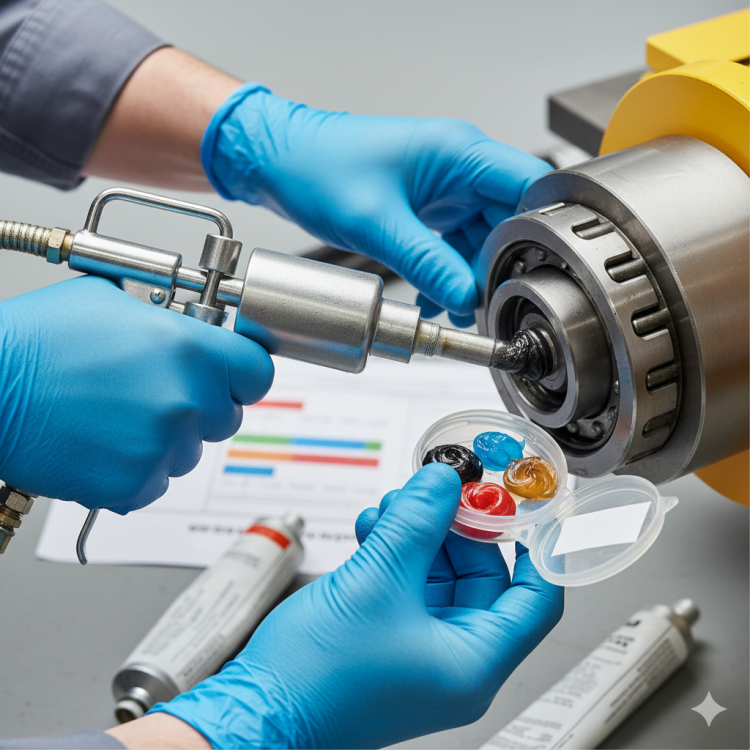
Grease is one of the most common components in any maintenance routine. But it has a major influence on how reliably your equipment performs. In many workplaces, people use whatever grease is available or rely on a single product for every machine. But the truth is that different equipment operates under different temperatures, loads, speeds, and environmental conditions; and each of these factors demands a specific type of grease.

When the wrong grease is used, the effects are subtle at first. Bearings run slightly hotter, components wear a little faster, and lubrication intervals shorten without any obvious warning signs. Over time, these small changes build up, and eventually lead to premature failures, higher maintenance costs, and avoidable downtime.
This is why choosing the right grease isn’t just a routine decision, it’s a practical, technical choice that directly affects performance, efficiency, and equipment life.

In this article, we will break down the major types of grease, explain how each one works, and show you how to match the right formulation with the demands of your machinery.
Why Do You Need To Grease Your Equipment?
Grease is fundamentally a mixture of three components: base oil, thickener, and additives. The base oil provides the actual lubrication, the thickener gives grease its semi-solid structure, and additives enhance performance under various conditions. Grease, unlike other regular lubricating oils, stays in place, making it ideal for components that:
- Require long-term lubrication
- Operate under high pressure or heavy loads
- Are exposed to dirt, water, or contaminants
- Cannot be lubricated frequently
The right grease helps reduce friction, maintain temperature stability, minimize wear, and protect surfaces from corrosion.
Components That Define Grease Performance
Before choosing a grease, it is important to know what are the elements which constitute the grease.
1. Base Oil
The base oil usually determines viscosity and temperature resistance. There are two primary types:
- Mineral oil - General-purpose applications
- Synthetic oil - High heat, extreme cold, or precision equipment
Higher viscosity oils handle heavier loads, while lighter viscosities are ideal for higher-speed components.
2. Thickener
The thickener acts like a sponge that holds the base oil. It also influences melting point, water resistance, and structural stability. Some common thickeners include:
- Lithium & Lithium Complex - Versatile and widely used
- Calcium Sulfonate - Strong water resistance, excellent load capacity
- Polyurea - Long life, ideal for electric motors
- Aluminum Complex - Common in food-grade grease
3. Additives
Additives strengthen the grease for specific conditions, such as:
- Anti-wear (AW) protection
- Extreme pressure (EP) capability
- Corrosion resistance
- Oxidation control
The additive package is especially important for heavy-duty and high-stress applications.
Which Are The Main Types of Greases?
1. Lithium Grease
Lithium grease is the most widely used general-purpose grease. It handles everyday operating temperatures well, stays stable when the equipment is running, and resists water reasonably well.
Because of this balance, it works effectively in common applications like bearings, automotive parts, and general machinery. If your equipment operates under normal loads and conditions, lithium grease is often the most practical choice.
2. Calcium Sulfonate Grease
Calcium sulfonate grease is known for its excellent water resistance and natural ability to handle pressure. This makes it ideal for wet, humid, or corrosive environments such as marine equipment, outdoor machinery, or areas exposed to steam and chemical washdowns. It also protects metal surfaces from rust, which is especially important for equipment exposed to moisture.
3. Polyurea Grease
Polyurea grease is commonly used in electric motors because it can run for a long time without breaking down. It handles heat well, resists oxidation, and maintains smooth performance at high speeds. Since many electric motors are not easy to relubricate frequently, polyurea grease is a reliable choice for applications where long service life is important.
4. Molybdenum Disulfide (Moly) Grease
Moly grease contains molybdenum particles that form a protective layer on metal surfaces. This layer helps reduce wear when equipment is under heavy pressure or experiences sudden impacts. It is widely used in construction and mining machinery, especially in joints, pins, and bushings that face constant load and vibration. Moly grease is a strong option when your machine works in tough, high-pressure conditions.
5. Synthetic Grease
Synthetic grease is made with advanced synthetic oils, allowing it to perform well in extreme temperatures—both very hot and very cold. It stays stable for long periods, reduces friction, and provides reliable lubrication in sensitive or critical equipment. While synthetic grease is more expensive, it is often the best choice for aerospace, precision machinery, and systems that cannot risk lubrication failure.
6. Aluminum Complex Grease
Aluminum complex grease performs well in environments where equipment is often washed or cleaned. It sticks well to metal and resists water, which makes it suitable for food processing, packaging, and pharmaceutical machinery.
As there are many aluminum complex greases are available in food-grade formulations, they can safely be used in facilities where hygiene standards are strict and contamination must be avoided.
But, how will you determine the thickness of the grease that you are using? The NLGI (National Lubricating Grease Institute) number tells you how thick a grease is:
- NLGI 000–1: Very soft for gearboxes and very cold environments
- NLGI 2: Most common for general machinery
- NLGI 3: Thicker option for higher temperatures
NLGI 2 is the industry standard unless specified otherwise.
Common Mistakes to Avoid While Selecting Your Grease
Even skilled technicians can face lubrication issues when small details are overlooked. Some common mistakes that you need to avoid making are stated below.
1. Choosing the Wrong Viscosity
Viscosity describes how thick or thin the base oil inside the grease is. When the viscosity is too low, the grease cannot form a strong enough film to protect metal surfaces, especially under heavy loads. This leads to increased friction and faster wear. On the other hand, a grease that is too thick can cause excessive drag, overheating, and higher energy consumption in fast-moving parts.
2. Over-Greasing Bearings
Over-greasing is one of the most common causes of bearing failure. When too much grease is added, it creates excess pressure inside the bearing housing. This pressure causes heat buildup, pushes grease into areas where it shouldn’t go, and can even damage seals. Over time, the bearing runs hotter and loses efficiency.
3. Ignoring Relubrication Intervals
Every grease has a service life. If it is not replenished at the correct interval, it begins to dry out, oxidize, or lose its ability to protect metal surfaces. Factors such as temperature, speed, and load influence how quickly grease breaks down. Ignoring re-lubrication schedules leads to increased friction, contamination, and eventual failure.
4. Mixing Incompatible Greases
Different greases use different thickeners (like lithium, polyurea, calcium sulfonate), and many of them are not compatible with each other. Mixing incompatible greases can cause the mixture to soften or harden unexpectedly, reducing lubrication quality and creating a risk of sudden equipment failure. The safest approach is to avoid mixing greases altogether unless you are absolutely sure they are compatible. When changing grease types, always clean or purge the old grease from the system.
Final Takeaway
The thought behind selecting the right type of grease may seem like a small decision, but it has a major impact on how reliably your equipment performs. When you understand your machine’s temperature range, load demands, operating speed, and environmental conditions, the picking process becomes much easier and far more effective. And above all, let the OEM recommendations guide your final decision. They reflect how the equipment was engineered to perform, and will make sure your choice of grease supports your equipment rather than risking it.





