

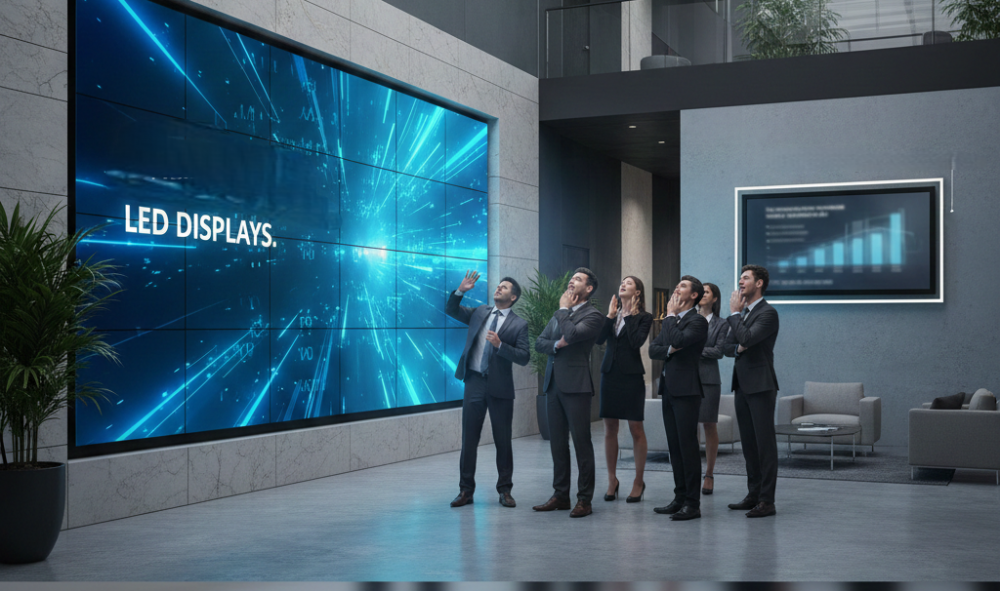
Digital screens like indoor LED displays and LCD screens have become an essential part of modern business communication. Be it a retail store, a corporate lobby, an event hall, or a hospitality venue, display boards help the audience to understand what brands are trying to convey.
However, when it comes to choosing a digital display, people often get confused about whether they should go for an LED display or an LCD Screen.
This blog breaks down the fundamentals. What LED displays really are. Whether you need a reliable indoor LED display manufacturer. How LCD screens work, and the difference between them. Let’s take a look at:

What Is an Indoor LED Display?
An indoor LED (Light-emitting diode) display is a modular digital screen made of small diodes that emit light. Each diode acts like a pixel. When thousands of these LEDs light up together, they form images, text, and videos. This is why choosing a reputable indoor led display manufacturer matters.
Characteristics define LED displays:
- They emit their own light, so they stay bright even in well-lit indoor spaces.
- They come in panels or cabinets, which you can piece together like tiles to create small screens, long strips, or massive video walls.
- They offer flexible pixel pitches, often ranging from 0.9mm to 3mm for indoor use.
What Is an LCD Screen?
The full form LCD is Liquid Crystal Display. Here, the screens use an LED-based backlight. But the image itself is generated through liquid crystals that twist to allow or block light.
Characteristics of LCD Screens
- They are flat panels, usually available in fixed sizes (32”, 43”, 55”, 65”, etc.).
- They rely on backlighting, so the image quality depends on how well the backlight spreads across the panel.
- These screens offer high resolution at a lower cost for smaller sizes.
LED vs. LCD: Understanding the Differences
Let’s take a look at the differences between these two displays:

|
Feature |
LED Display |
LCD Screen |
|
Brightness & Clarity |
Very bright, sharp, and consistent even in strong ambient light. |
They are also bright. But if you use them under intense lighting, they might look washed out. |
|
Viewing Angle |
Wide viewing angles up to 160. This means the visuals are clear from almost any direction. |
Viewing angles vary by panel type, for instance, IPS performs better than VA. May lose color accuracy from the sides. |
|
Seamlessness |
Modular panels fit together without visible bezels, creating a smooth, uninterrupted canvas. |
Multi-screen setups show bezel lines, breaking the visual flow. |
|
Longevity & Maintenance |
They have a long lifespan (80,000–100,000 hours). You can also maintain it easily. Just replace individual modules, no need to change the whole display. |
Decent lifespan. But if a panel fails, you have to replace the entire screen. |
|
Custom Sizes & Shapes |
Highly flexible. So, they can support large walls, curved designs, ceilings, ribbons, pillars, and creative layouts. |
Limited to fixed, standard rectangular sizes (32”, 43”, 55”, etc.). Creative shaping is not possible. |
Why So Many Businesses Now Prefer Indoor LED Displays
If you look closely in the above table, you will see that LED displays offer several advantages. However, you do have to choose a trusted indoor LED display manufacturer.
1. They Offer Strong Visual Impact
For any business, grabbing attention is the first thing they want. They want the screen to hold interest and deliver crisp messages. LED technology creates richer colors and more vivid contrast. Even from a distance, the picture remains clearly visible. These are ideal for stores, showrooms, or hotel lobbies.
2. They Are Flexible in Design & Scale
Business demands vary. You might need a display screen for an 8 or 10-foot wall, or a curved corner. LED displays meet all these demands. When you choose the best LED display manufacturer, you get a screen that can bend, tile, and scale without restrictions. This level of design freedom is nearly impossible with LCD screens.
3. They Reduce Long-Term Burden
Even though upfront cost plays a major deciding factor, businesses still have to consider the overall lifecycle cost. LED screens can be more expensive than LED screens. But if you consider the long-term reliability, then make up for it. Damaged LCD screens are really expensive because you have to panel means replacing the entire screen, whereas replacing only individual LED modules or diodes suffice. This also means that the downtime is much lower. You also get stable brightness even if you get a little older.
4. They Work Smoothly in Large, Bright, or Open Spaces
LED displays are famous with businesses for advertising. If your space has spotlights, glass walls, or heavy overhead lighting, then an LCD screen might not be suitable. Their backlit system simply cannot match the power of direct-emitting LEDs.
LED displays deliver consistent brightness and balanced color even in:
- Malls
- Airports
- Convention centers
- Car showrooms
- Hotel lobbies
The Bottom Line
Advertising for businesses like retail showrooms, airports, corporate offices, hotels, and event venues, appearance matters. You can’t take a chance with how the advertisement looks when a passerby looks into the digital screen, because that’s what captures their attention. If you want high impact, seamless visuals, long-term reliability, and design freedom, indoor LED displays offer better advantages. They handle brightness, scale, and durability far better than LCD screens. However, when purchasing a model, go for an indoor LED display manufacturer. Because that’s how you get the best value for your purchase.





