

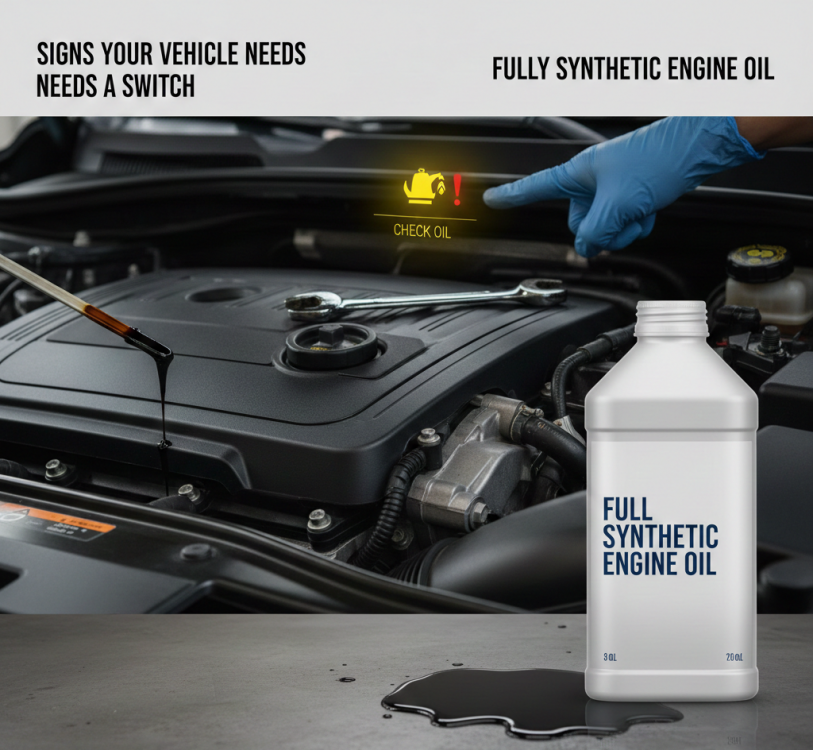
If you’ve been driving your vehicle for a while, you can usually sense when something isn’t right. Maybe the engine feels a bit cranky when you cold start it in the morning. Maybe the fuel economy isn’t the same it used to be. These ain’t something normal; rather, it’s a sign that your engine is showing signs of warning that something is wrong.

After a certain time period, your vehicle’s engine oil needs to be changed, and what worked before may no longer be required now. That’s when upgrading to fully synthetic engine oil becomes the best decision. It isn’t about sounding premium or technical. It’s about giving your engine the kind of protection that matches today’s driving conditions — heavy traffic, hotter engines, longer commutes, and more demanding components.
In this article, you will learn about what are the signs that your vehicle shows when the existing engine oil is not able to deliver the required performance and needs a better engine oil option.
What’s Fully Synthetic Engine Oil?
For those who don’t know about fully synthetic engine oil, it is an advanced , laboratory-engineered oil that is designed to offer the highest level of engine protection. They are refined from crude petroleum. IIts molecules are uniform and stable, allowing it to withstand extreme temperatures without breaking down. This makes it especially useful for modern engines that overheat faster, and require cleaner lubrication.

Signs Your Vehicle Needs Fully Synthetic Engine Oil
Here are some of the most probable indicators technicians inspect during vehicle inspection. When you spot them early, it can make a huge difference in your engine’s long-term health.
1. Engine Sounds Different
Is your car sounding louder in the mornings or when standing idle? It usually means the oil isn’t maintaining its thickness. As the oil thins, it can’t lubricate the engine parts properly. Fully synthetic engine oil keeps its viscosity stable even in colder temperatures, so the engine sounds and feels smoother during everyday use.
2. Too Much City Traffic
Daily city driving puts a good amount of load on the engine. Constant braking, crawling speeds, and repeated heating cycles cause regular oil to degrade quickly.
Synthetic oil stays stable under these stop-and-go conditions, giving the engine steady protection throughout your commute.
3. Oil Gets Dirty Early
If your oil becomes dark and thick far sooner than the recommended interval, it means the engine is generating carbon deposits and the oil isn’t able to suspend them effectively. Dirty oil reduces lubrication and can increase wear over time.
Fully synthetic oil resists sludge formation, and stays usable for a longer duration.
4. Mileage Drops
If your vehicle used to give 15 km/l and now you suddenly see the mileage has drastically dropped to 12–13 km/l, it’s obvious that there’s something wrong with the engine oil you are using. This usually happens when your engine has more friction because the oil has worn out. When the oil can’t lubricate properly, the engine has to add extra power as a result of which your vehicle consumes extra fuel.
When you replace your old engine oil with a fully synthetic oil, it reduces this friction and improves your mileage back again.
5. Engine Overheating Issue
Just as you keep a tab on your fuel meter in the instrument cluster, in the same way keep a watch on the temperature gauge as well. If the temperature gauge rises more often or the bonnet feels hotter than usual, your oil may be losing its ability to withstand heat. Thin or unstable oil cannot carry heat away properly.
What can be the solution to this? Upgrade to a fully synthetic oil as it is capable of performing better under high temperatures, and keeps your engine cool always.
6. Turbo or Modern Engines
If you’re driving a turbocharged car, your engine works in a very different environment than a regular one. Turbocharged engines tend to heat up extremely fast, often over 1,50,000 RPM.
Fully synthetic oils like 5W-40, or 5W-30 (ACEA A3/B4 or API SP) are usually the best match for turbo engines.
7. Oil Level Drop
If you notice that you need to top up your engine oil more often than before, it’s a clear sign something isn’t right. A quick DIY check can confirm it:
- Pull out the dipstick,
- Wipe it clean,
- Reinsert it, and
- Check the level again.
If the oil level keeps dropping between services, your current oil may be evaporating due to heat or slowly burning off inside the engine.
Fully synthetic oil can help you overcome this problem because it has a much lower evaporation rate. This means your oil level remains more stable, and you don’t have to worry about frequent top-ups.
8. Longer Service Gaps
Your car’s routine service date is coming up, but your schedule is packed and you’re thinking, “Can I push it a little?” If you’re using regular oil, that’s usually risky because it breaks down faster. But with fully synthetic engine oil, you get that extra flexibility. It stays stable for more kilometres and keeps the engine protected longer. So even if you’re running a bit late for your next oil change, your engine is still safe.
Things To Remember When You Are Changing Your Engine Oil
There are certain things that you should keep in mind when you are changing your vehicle’s engine oil.
Follow Correct Grade
Always use the oil grade recommended by your vehicle manufacturer. The right viscosity gives better protection to your engine, and provides stable performance in all driving conditions..
Change the Filter
Whenever you switch to synthetic oil, make sure you install a fresh oil filter. A clean filter allows your car engine to breathe freely and allows it to run at its full potential.
Avoid Mixing Oils
If you’re switching to synthetic oil, don’t mix it with whatever is already in the engine. Make sure you drain the existing oil. But, if you don’t do that, and mix the old oil with the new synthetic oil, it degrades your vehicle’s performance and defeats the purpose of upgrading.
Final Takeaway
If your engine sounds different, the mileage drops, or the oil gets dirty faster, it’s a clear sign it needs better protection. When you take your vehicle to the service center, service advisors often recommend switching to fully synthetic engine oil for this very reason. Ignoring that advice may save a little now, but it can lead to costly repairs in the future.





