

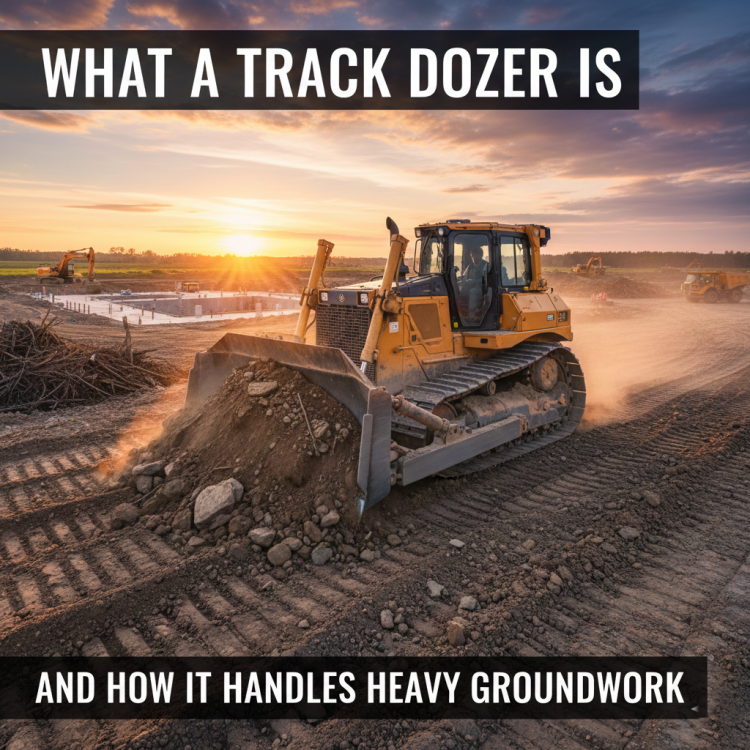
A bulldozer is something you have often seen on construction fields. But have you ever wondered how they work? What enables these track dozers to move extremely heavy objects like rocks and debris from one point to another? We aim to put a spotlight on all these questions in this article and see what makes the track dozer the champion of heavy groundwork.
What is a Track Dozer?
The basic mechanism is very similar to a battle tank, as they both manoeuvre via their tracks. It is a heavy-duty c that has metal plates or blades equipped at the front end. What sets these dozers apart from the large rubber-tired ones is their capability to move on continuous metal treads. Their tracks are what allow them to distribute their massive weight over a large surface area.

This process of weight distribution is also known as floating, which prevents the vehicle from sinking into the soft ground, mud or even sand. Thus, a track dozer, which may weigh around 50 tons, with this process exert way less pressure per square inch on the ground than a human standing on one foot would. Such a mechanism puts dozers in a completely different league than wheeled machines that concentrate their weight on their tyres entirely.
What Lies Inside a Track Dozer?
A bulldozer is not just a heavy machine with a shovel on tracks. Various other components come together to make it one of the most important machines in this sector. Among these components, the blade serves as the most distinct part of a dozer. It is basically a heavy steel plate that is used to push a variety of materials like soil, sand, debris and rubble. However, there are different types of blades depending on the type of task.

S-blade or Straight blade is best suited for fine grading tasks along with handling dense materials. On the other hand, the Universal or U-blades are designed to have a carved scoop with large side wings to keep material from spilling. Such a design helps them to push huge piles of material even over a long distance. Whereas the Semi-Universal or SU-blade is a hybrid that offers the excellent penetration of a straight blade and the pushing capacity of a U-blade.
Apart from blades, the undercarriage is another important part of a track dozer. Without these tracks, the entire machine will not be able to move at all, nor perform its duties efficiently. But their undercarriage is a complex system of sprockets, rollers, and idlers that all come to function in sync to move the chain tracks. Each metal plate or shoe makes up these tracks, combined with raised ridges on them, known as grousers. These ridges function similarly to the cleats of a football shoe. Thus, the deeper the grousers are, the more hold on the ground the dozer will have, even on loose soil.
The Ripper and the Final Drive
If the blades are important for pushing or moving purposes, the ripper works as a hook to claw to rip things off. You will find this module at the rear end of the track dozer, which is hydraulically lowered into the ground. Such a position helps it to break the hard-packed object like soil, pavement, or frozen ground, which the blade moves later. Thus, without a ripper, the blade will pretty much become useless.
However, the final drive is the gear reduction system of a bulldozer and the final piece of the puzzle. It is a transmission system that gears down the speed of the engine to increase its torque. Without it, the dozer will not have the rotational force to turn its tracks. Remember, this heavy machine is not about to compete in a race; a dozer prioritises torque over speed, which means they don't need to be fast but continuous.
How a Track Dozer Handles Heavy Groundwork?
Now that we know what makes a track dozer, let us focus on this functionality. At the core, it is designed to do one important task: earthmoving. It does not need to lift or carry materials like a loader, but it has to rip and tear through its obstacles. For that, it needs an excellent grip on the surface, even on soft ground. Remember, pushing a 10-ton pile of dirt with a wheeled truck will likely cause the wheels to spin due to the dirt's resistance exceeding tyre friction.
A normal wheeled vehicle simply won't cut it, but a dozer overcomes this by implementing the coefficient of traction. Which in simple language means the steel tracks of the dozer bite into the ground by simply applying its massive weight. Thus, when the engine pushes, the energy goes entirely into moving the load, not spinning the tracks.
Moreover, operators use slot dozing that enables them to handle massive amounts of heavy materials easily. This is a process that involves making passes on the same path and creating a slot or trench. The sides of this trench contain dirt that acts as walls, allowing the dozer to push nearly 30% more material per pass compared to flat ground.
Conclusion
From tearing apart hard rocks with its ripper to moving earth with its blades, the track dozer has proven to be a valuable part of the construction and mining industry. It does not matter what terrain you are working on; with its metal tracks always gripping the ground firmly, the bulldozer is always ready to push through any obstacles thrown at it. If you are working on projects that involve challenges like soft, muddy, rocky, or uneven terrain or need to literally reshape the earth, like clearing a forest, ripping up old asphalt, or pushing overburden in a mine, then a track dozer is the best option.





