
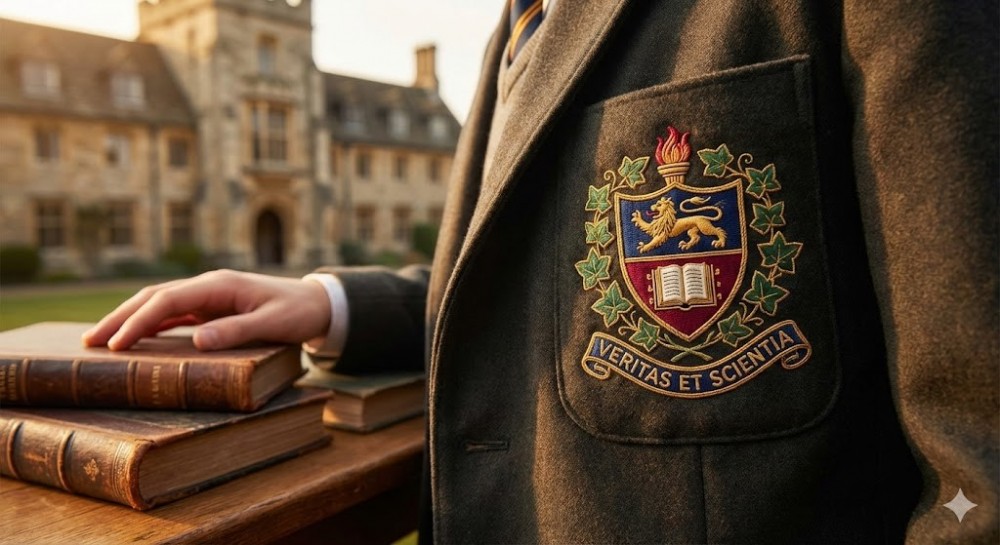
In the corridors of education, history is not just found in textbooks; it is worn on the chest. Walk into any school assembly hall in Ireland—or indeed, across much of the world—and you will see a sea of uniforms. But look closer. On the pocket of a blazer, the breast of a jumper, or the lapel of a prefect’s jacket, sits a small, intricate design that tells a story spanning generations. This is the school crest.
In an age of rapid rebranding and minimalist corporate logos, the school crest remains a bastion of tradition. It is a symbol that commands respect, evokes nostalgia, and fosters a deep sense of belonging. But what exactly makes these emblems so powerful? And how can schools ensure that their crest continues to inspire pride in a modern educational landscape?
This guide explores the history, the hidden meanings, and the modern application of the school crest, demonstrating why this small piece of design is one of the most important assets an educational institution possesses.

The Heraldry of Education: A Brief History
The concept of the school crest is deeply rooted in the ancient tradition of heraldry. Originally used in medieval times to distinguish knights on the battlefield, coats of arms eventually became symbols of identity for families, towns, and guilds. As schools and universities were founded—often by religious orders or wealthy patrons—they adopted this visual language to assert their authority and lineage.
Unlike a modern corporate logo, which is designed primarily for marketing recognition, a school crest is designed to convey values. It is a visual manifesto.
-
The Shield: Represents protection and strength.
-
The Open Book: A universal symbol for learning, scripture, and the pursuit of knowledge.
-
The Torch or Flame: Signifies enlightenment, truth, and the passing of wisdom from one generation to the next.

-
The Latin Motto: Perhaps the most defining feature. Phrases like Veritas (Truth), Sapere Aude (Dare to Know), or Fides et Robur (Faith and Strength) act as a guiding philosophy for the student body.
In Ireland, we often see these classical elements blended with local heritage—Celtic knots, harps, shamrocks, or the specific iconography of saints associated with the school’s founding. This fusion creates a unique identity that links the student not just to the school, but to the land and culture from which it grew.
The Psychology of Belonging
Why does the design of a school crest matter so much to the students? The answer lies in the psychology of "tribal" belonging. Adolescence is a time of identity formation. Students are constantly seeking their place in the world. The school uniform, anchored by the crest, provides an immediate answer: "I belong here."
When a First Year student puts on their uniform for the first time, they are literally "badging" themselves into a community. They are inheriting the reputation earned by thousands of alumni before them.
Conversely, a poorly designed or cheaply produced crest can have the opposite effect. If the embroidery is fraying, or the design looks dated and irrelevant, it can subtly undermine pride. A sharp, distinct, and high-quality crest, however, instills a sense of discipline. It suggests that the institution cares about standards, and by extension, expects high standards from its pupils.
The School Crest in the Digital Age
One might assume that in 2025, digital branding would render the traditional crest obsolete. In fact, the opposite is true. As schools increasingly compete for enrollment and seek to maintain strong alumni networks, the brand identity has become critical.
However, a school crest faces a unique challenge: it must be versatile. It needs to look as good on a smartphone screen (for the school website and app) as it does embroidered onto a heavy wool blazer or cast into a metal pin.
This has led to a trend of "sympathetic modernisation." Many historic schools are refining their crests—cleaning up cluttered lines, adjusting colour palettes for better contrast, and simplifying complex heraldry—without losing the core essence of the original design. The goal is to ensure the crest remains recognizable instantly, whether it is on a massive sports hall banner or a tiny favicon on a browser tab.
From Design to Fabric: The Art of the Badge
While the graphic design of a school crest is important, its physical execution is where it truly comes to life. A crest is meant to be worn. This brings us to the importance of manufacturing quality.
There are several ways a school crest is typically reproduced, and choosing the right method is essential for durability and aesthetics:
1. Traditional Embroidery
This is the standard for blazer pockets and PE kits. Threads are stitched directly into the fabric or onto a patch.
-
The Benefit: It offers texture and a classic look.
-
The Drawback: It can struggle with very fine detail or small text, which can sometimes become illegible.
2. Woven Badges
For crests with intricate details, Latin mottos, or complex Celtic knotwork, woven badges are superior. By weaving the threads together (rather than stitching on top of a base), a much higher resolution is achieved. This ensures that the school motto is actually readable, not just a blur of thread.
3. Enamel Lapel Pins
These are the jewels of the school uniform. Used often for Prefects, Student Council members, or house identification, enamel pins turn the crest into a piece of jewellery. A die-struck metal pin with hard enamel filling exudes prestige and authority.
The Role of the Supplier
Given the importance of the school crest, trusting its production to the lowest bidder is a risk. A school uniform is washed hundreds of times; the crest must survive every cycle without fading or unravelling. Furthermore, the colours must be exact. "Navy Blue" varies wildly between manufacturers; a school needs its specific Pantone shade of navy to match the official branding.
This need for precision and durability is why many educational institutions in Ireland turn to specialists rather than generalist printers.
Partnering with Excellence: Abbey Badges
One such specialist that has earned the trust of schools across the country is Abbey Badges. Based in Dublin, they understand the specific nuances of the Irish education sector. They know that a crest is not just a commodity; it is the face of the school.
What makes Abbey Badges particularly valuable to schools is their ability to handle the full spectrum of crest applications. They don't just do one thing. If a school needs thousands of woven patches for the incoming First Years’ tracksuits, high-end enamel pins for the Student Council, and perhaps a commemorative medal for a centenary celebration, Abbey Badges can ensure the school crest looks consistent across all formats.
Their design team is also adept at helping schools navigate the tricky waters of updating a crest. If your current emblem is blurry or exists only as an old jpeg, their free design service can redraw and digitise it, making it production-ready for everything from stationery to signage. They respect the history of the crest while ensuring it is crisp enough for modern manufacturing.
For Principals, Boards of Management, or Parents' Associations looking to upgrade the quality of their school's insignia, a consultation with their team offers a blend of traditional service and modern quality control. You can view their portfolio of educational badges and request a quote at abbeybadges.ie.
Conclusion: Wearing History
The school crest is a small canvas, but it carries a heavy weight. It carries the history of the founders, the memories of the alumni, and the aspirations of the current students. It appears in the background of graduation photos, on the jerseys of winning teams, and in the treasured keepsake boxes of grandparents.
It is a constant in a changing world.
Therefore, how that crest is presented matters. It deserves to be reproduced with care, using materials that last and designs that shine. Whether it is embroidered, woven, or cast in metal, a high-quality crest is a daily reminder to every student that they are part of something bigger than themselves. It is a badge of pride, and it deserves to be worn well.





