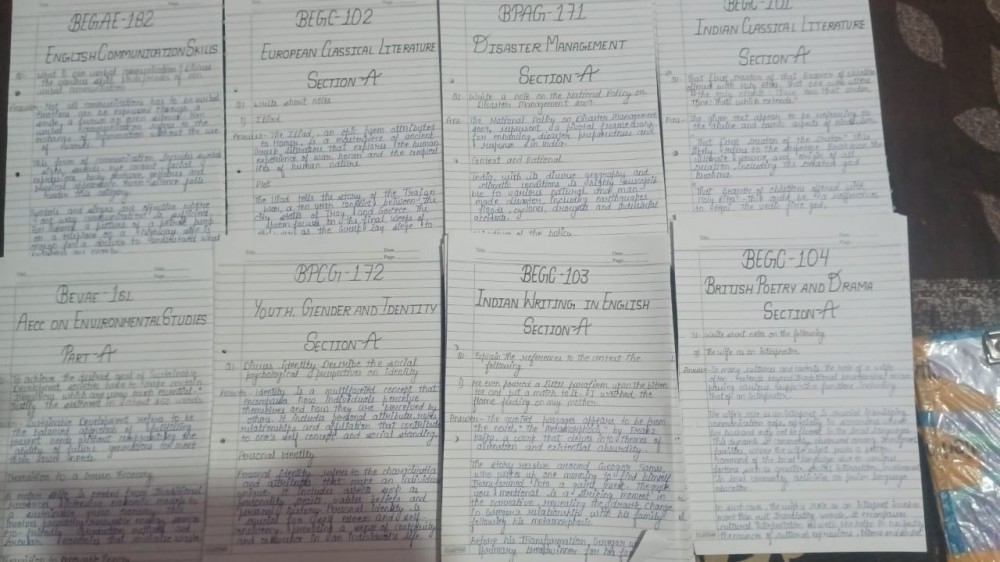
Imagine pouring hours into your studies, only to lose marks because your IGNOU Handwritten Assignment doesn't meet basic rules. These assignments carry up to 30% of your final grade in many courses. Students often juggle busy lives with tough topics, making perfect submissions a real hurdle.
This guide gives you a clear path to top scores. You'll learn the right format, strong content tips, and smart submission steps for IGNOU handwritten assignments. By the end, you'll handle every detail like a pro.

IGNOU sets strict rules for handwritten assignments to keep things fair and easy to grade. Following them shows you respect the process. Skip these, and your work might get rejected outright.

Start with A4 white bond paper—it's the standard for IGNOU handwritten assignments. Use one side only to avoid bleed-through. Margins matter: leave 1.5 inches on the left for binding, and 1 inch on the right, top, and bottom.
This setup makes your pages look clean and official. Think of it like framing a picture—good borders highlight the content inside. Always check your study center for any local tweaks, but these basics hold true everywhere.
Your cover page needs key details first. Write your enrollment number at the top, followed by the course code, assignment code, and full title. Add your name, signature, and the date below—neatly in the center.
Next comes the index page. List all questions or sections with page numbers. It helps evaluators jump around quickly. For example, if your IGNOU assignment covers five questions, number them 1 through 5 and note where each starts.
A solid front page sets a strong tone. Mess it up, and graders might start off on the wrong foot.
Assemble pages in order: cover, index, then answers, ending with any declarations. Staple from the top left—never use loose sheets or folders unless asked. Include a submission slip if your program requires it; B.Ed. students need one for practicals, while MBA folks might skip it.
For file ordering, keep everything sequential. Number each page in the top right corner. This prevents mix-ups during evaluation.
Centers vary, so ask ahead. Some want originals only; others accept copies with proofs.
Format is just the start—content wins the real points in IGNOU handwritten assignments. Evaluators look for clear answers tied to your study materials. Make yours stand out with smart structure and facts.
Read each question twice before you write. IGNOU questions often have parts, like "Explain A and discuss B." Break them down: answer A fully, then B, using space based on marks—say, half a page for 5 marks.
Allocate time wisely. If a question is worth 20 marks, give it more room than a 10-mark one. Use headings for each part to guide the reader.
This strategy keeps your IGNOU assignment focused. It's like mapping a road trip—you hit all stops without getting lost.
Pull from your Self-Learning Material (SLM) as the main source—it's what evaluators expect. Quote key lines and explain them in your words. For citations, note the page number in brackets, like (SLM, p. 45), if needed.
Avoid copying straight—paraphrase to show understanding. Plagiarism checks are rare for handwriting, but originality matters. Mix in examples from real life to back your points.
Strong sources build trust. Your answers feel solid, not shaky.
Draw diagrams when words fall short, like in history timelines or science processes. Use a ruler for straight lines and blue pen for labels—keep it simple and large. A neat flowchart can sum up a long explanation in half the space.
Tables work great for comparisons; list pros and cons side by side. In technical courses, they save time and clarify data.
Visuals boost scores by 10-15% in some cases, based on student feedback. They make complex ideas pop without extra text.
Handwriting isn't just writing—it's your first impression in IGNOU handwritten assignments. Poor script can hide good ideas. Focus on clarity to let your smarts shine through.
Pick a ballpoint pen for smooth flow; gel pens smudge less on cheap paper. Stick to blue or black ink—red is only for underlining headings if allowed. Test it on scrap paper to ensure even lines.
Consistency matters. A fresh pen avoids skips midway. Dull ones lead to faint words that frustrate readers.
Right tools make the job easier. You'll write faster and cleaner.
Aim for medium letter size—easy to read from arm's length. Space words evenly, about one finger width, and leave a line between paragraphs. Align text to the left margin for a tidy look.
If your handwriting wobbles, practice on lined sheets first. Then transfer to plain paper. It takes a few tries, but uniformity pays off.
Think of it as a garden—neat rows make everything grow better, or in this case, score higher.
Spot a mistake? Draw a single line through it—no big scribbles. Write the fix above or in the margin. Skip white-out; it looks messy and can smear.
After drafting, read aloud to catch more errors. This keeps your IGNOU assignment polished.
Clean edits show care. Graders notice and reward it.
Not all IGNOU handwritten assignments are the same—programs tweak the rules. Tailor your approach to fit. This section covers key differences to avoid surprises.
TEE assignments are short, question-based tasks tied to exams. Keep them to 500-1000 words per question, focused on SLM. Project reports, like in final years, run 20-50 pages with research and analysis.
For projects, add an abstract and bibliography. Scope is wider—include fieldwork if needed. Rigor means deeper insights, not just summaries.
Spot the type early. It shapes your whole effort.
In science streams, document labs step by step. Start with aim, then materials, procedure, observations, and results. Use tables for data; draw graphs freehand but accurate.
Handwrite observations right after the experiment—fresh notes beat memory. For technical courses, include circuit sketches with labels.
This format proves hands-on skills. It's key for passing practical credits.
For management or social sciences, structure cases like this: intro to the issue, facts, analysis, and solutions. Use bullet points for options in handwriting—keeps it scannable.
Present findings clearly; underline key recommendations. Tie back to theory from your course books.
Strong cases show real-world thinking. They often tip borderline grades upward.
You've written it—now don't drop the ball. Review and submit right to lock in those marks for your IGNOU handwritten assignment. These steps seal the deal.
-
Check page numbers: Every sheet from 1 to end.
-
Include declarations: Sign the plagiarism form at the back.
-
Scan for smudges: Wipe any ink spots; ensure no folds.
-
Verify completeness: All questions answered? Cover page correct?
Go through this list twice. It catches small slips that cost big.
A quick review saves headaches later.
Deadlines hit in April and October—mark your calendar now. Late submissions get penalties, up to zero marks in worst cases. Drop off in person at your center; some accept scans via email, but confirm.
Centers have set hours, often weekends. Arrive early to beat lines. Ask for a receipt every time.
Timely action keeps your grades on track.
Photocopy the full set before handing over. Keep the copy safe for re-checks or appeals. Scan pages into a PDF on your phone for digital backup—easy access.
This protects against loss or disputes. Many students regret not doing it after mix-ups.
Backups give peace of mind. Your hard work stays yours.
Mastering IGNOU Solved Assignment blends sharp content with crisp presentation. Follow this guide, and you'll turn challenges into high scores. Every detail counts toward your degree.
-
Prioritize neat handwriting—it's half the battle for good marks.
-
Always include the cover page and index; they guide evaluators.
-
Back up your work—photocopies prevent future stress.
-
Review deadlines early to avoid late fees.
Apply these tips today. Your next submission could be your best yet. Start practicing now for that top grade.