

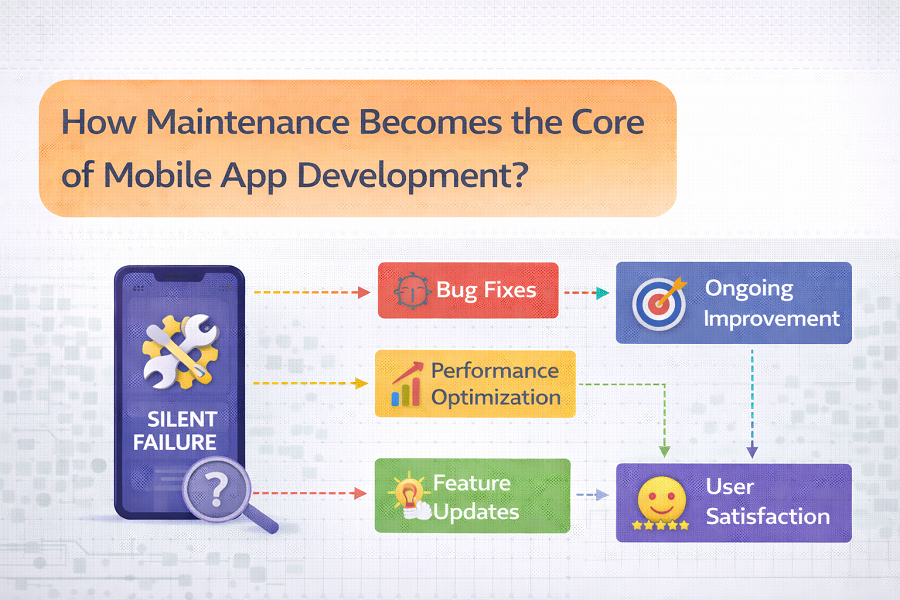
I used to think maintenance was what happened after the real work was done.
You ship the app.
You celebrate.
Then you “maintain” it while planning the next big thing.
That belief lasted exactly one serious production year.
By the end of that year, I wasn’t spending most of my time building new features. I was spending it keeping existing ones alive. Fixing edge cases. Updating dependencies. Adjusting behavior to new OS versions. Calming systems that worked yesterday but felt unstable today.
That was when I understood something most teams learn late.
Maintenance isn’t a phase of mobile app development.
It becomes the core of it.
The Illusion That Launch Is the Finish Line
Early in a product’s life, development feels forward-moving.
New screens.
New flows.
New capabilities.

Everything is additive. Each sprint produces visible progress.
Then the app meets the real world.
Devices change.
Operating systems update.
User behavior evolves.
APIs deprecate.
Performance expectations rise.
Suddenly, the app isn’t just a thing you built. It’s a thing you have to keep compatible with reality.
That shift is subtle, but permanent.
Why Mobile Apps Age Faster Than We Expect
Mobile apps age faster than most software because their environment is unstable.
Operating systems release major updates every year.
Hardware capabilities change constantly.
Background execution rules evolve.
Privacy and permission models tighten.
What worked perfectly last year can feel broken this year without a single code change.
According to Statista, mobile OS updates reach large portions of the user base within months, not years. That means behavior changes propagate quickly.
Maintenance isn’t about fixing mistakes. It’s about adapting to moving ground.
The Hidden Work Users Never See
Users rarely notice when maintenance is done well.
They don’t applaud when the app survives a new OS version.
They don’t thank you when a dependency update prevents a crash.
They don’t celebrate when performance stays stable as features accumulate.
They only notice when maintenance is ignored.
Apps feel slower.
Battery drains faster.
Bugs feel random.
Trust erodes.
Maintenance is invisible success and very visible failure.
Why “Just One More Feature” Becomes Dangerous
Feature development is seductive.
It’s concrete.
It’s demoable.
It feels productive.
Maintenance work doesn’t feel that way.
Refactoring doesn’t change screens.
Dependency updates don’t impress stakeholders.
Removing dead code doesn’t show up in release notes.
So teams postpone it.
That postponement compounds.
Each new feature lands on older assumptions. Each workaround becomes permanent. Over time, the app grows brittle.
According to McKinsey, accumulated technical debt significantly increases long-term development costs and slows future delivery. Maintenance is how you pay that debt down.
Maintenance Is Where Most Reliability Is Won or Lost
Crashes rarely come from brand-new code.
They come from interactions between old code and new conditions.
An OS update changes lifecycle timing.
A permission model tightens.
A background task behaves differently.
Suddenly, stable logic isn’t stable anymore.
This is especially clear in environments like mobile app development Indianapolis, where apps often need to remain reliable across diverse devices, industries, and usage conditions rather than chasing novelty.
Reliability isn’t built once. It’s renewed continuously.
The Emotional Shift for Developers
There’s a psychological transition that happens quietly.
Early on, developers feel like builders.
Later, they feel like caretakers.
At first, that can feel discouraging.
Maintenance doesn’t feel creative.
It doesn’t feel innovative.
It doesn’t feel like progress.
Until you realize that without it, nothing else matters.
An app that can’t be trusted isn’t a platform for innovation. It’s a liability.
Maintenance Forces You to Confront Reality
Maintenance work exposes truths teams would rather avoid.
Which parts of the app are fragile
Which abstractions no longer fit
Which features are rarely used
Which assumptions were wrong
New development can hide those truths. Maintenance drags them into the open.
That’s uncomfortable.
It’s also healthy.
Why Mobile Maintenance Is Harder Than Backend Maintenance
Mobile apps don’t run in controlled environments.
They run on phones that are
Low on battery
Overheating
Switching networks
Running dozens of other apps
They’re paused, killed, resumed, and recreated constantly.
Maintenance means continuously revalidating assumptions about lifecycle, performance, and state recovery.
Backend systems change slowly. Mobile environments don’t.
The Cost of Skipping Maintenance Shows Up Later
Teams that delay maintenance don’t fail immediately.
They fail gradually.
Bug fixes take longer.
Releases become risky.
Developers fear touching old code.
Workarounds pile up.
Eventually, adding features becomes harder than rewriting the app.
By then, maintenance debt is no longer optional. It’s existential.
What Maintenance Actually Includes
Once I stopped thinking of maintenance as “cleanup,” the picture changed.
Maintenance includes
-
Updating dependencies and SDKs
-
Adapting to OS behavior changes
-
Revisiting performance assumptions
-
Simplifying overgrown abstractions
-
Removing unused features
-
Improving recovery and resilience
-
Strengthening observability
-
Revisiting user flows as behavior evolves
None of this is glamorous.
All of it is essential.
Why Maintenance Improves Velocity, Not Slows It
This surprised me the most.
After we invested consistently in maintenance, development sped up.
Code was easier to reason about.
Bugs were more localized.
Testing became more reliable.
Releases felt calmer.
Maintenance didn’t steal time from feature work. It made feature work possible.
The app stopped fighting us.
The Trust Connection Nobody Talks About
Users don’t know your roadmap.
They know how the app feels.
Does it survive updates
Does it remember their progress
Does it behave consistently
Does it feel calm
Those qualities come almost entirely from maintenance, not features.
Trust isn’t launched. It’s maintained.
The Lesson I Had to Learn the Hard Way
Maintenance taught me humility.
The app is never “done.”
The environment is never stable.
Assumptions always expire.
Once I accepted that, my relationship with the code changed.
I stopped chasing perfection.
I focused on resilience.
Maintenance stopped feeling like drudgery.
It started feeling like stewardship.
Conclusion: Why Maintenance Becomes the Core
Mobile app development doesn’t end at launch.
Launch is where responsibility begins.
From that point on, most of the real work is not about adding more, but about preserving what already exists while the world around it changes.
Maintenance becomes the core because it holds everything else together.
Features come and go.
Technologies shift.
Trends fade.
But an app that is cared for, adapted, and respected over time earns something far more valuable than novelty.
It earns trust.
And in the long run, trust is the most important feature you can ship.





